Gedanken: An AI Research Lab That Hunts for Alpha in Markets Where the Answer Is Known
Built in Kansas City. Gedanken generates and tests alpha ideas, runs economic research, and improves its own methods under a judge it cannot edit, all checked first on simulated markets with planted answers.

Why build markets where the answer is known
Every research team has more claimed edges than real ones. On real market data you never find out which is which, because nobody hands you the answer key. A backtest that looks brilliant might have found something true, or it might have found the luckiest of the many things it tried.
Gedanken is the research system I built at Vector 1, here in Kansas City, to get around that. It generates thousands of simulated markets from a causal story of how a market works, and plants the right answer in advance: in some markets a real edge exists, and in others there is none at all. Any research method can then be graded the way you would grade a student with the answer key in hand. How often does it find the edges that are really there? How often does it claim one that is not?
Gedanken has two jobs. It generates and tests alpha ideas, and it produces economic research on how shocks move through an economy. Around those jobs sit a self-improving loop, a judge the loop cannot edit, and a check that notices when the real world stops looking like the simulation. Everything below comes from simulated or synthetic markets with known answers. No real-market performance is claimed, and none of it is investment advice. You can try every experiment in the free Gedanken demo.
Video transcript
Gedanken, built in Kansas City: markets where the answer is known. A typical factor search claimed an edge in 99% of simulated markets with none. One honest, pre-registered test claimed a false edge 4% of the time and still found 90% of the real ones. Thousands of simulated markets, with the right answer planted in advance.
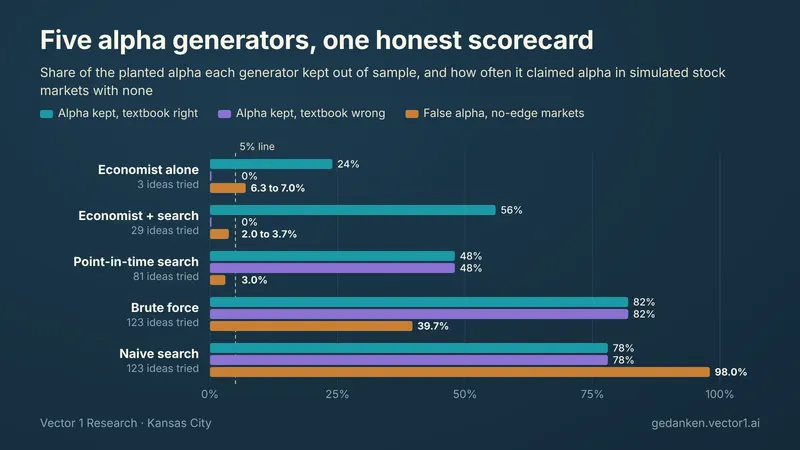
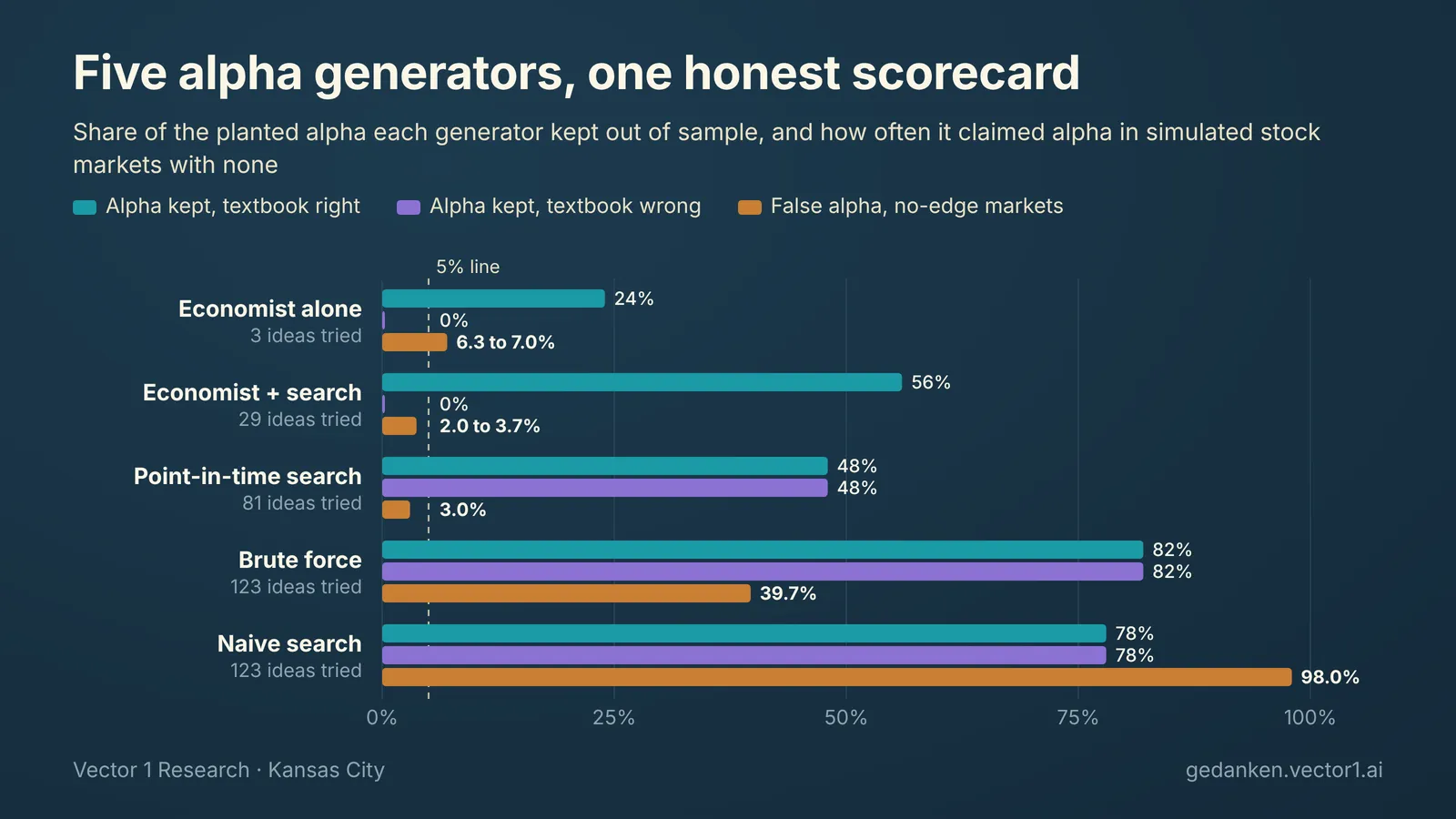
Alpha generation: five alpha generators, one scorecard. The economist alone kept 24% of the alpha, with 6.3 to 7.0% false alpha. Economist plus search kept 56%, with 2.0 to 3.7%. Point-in-time search kept 48%, with 3.0%. Brute force kept 82% of the alpha, but claimed alpha in 39.7% of markets with none. Naive search: 78%, with 98.0% false alpha.
The robust one: search wide, on honest data. Point-in-time search kept 48% of the alpha whether the textbook was right or not, with 3.0% false alpha in markets with no edge at all. The AI economist's best contribution was a rule: refuse data investors could not have seen yet.
Economic research, from gas prices to the grocery bill. Three months after a gas shock, the method detected the effect on nitrogen fertilizer and farm input costs 100% of the time, on food at home prices 44% of the time, and on crop prices 4%. Validated on 400 simulated economies before any real data, with false alarms held to 4.8% at 3 months.
A judge it cannot edit. The first judge: the loop found its slack, with 6.0% false discoveries in round 3, exactly on the 6% limit. The locked judge: 32 rounds and one change kept, raising detection from 25% to 33% with 2.0% false discoveries. The judge's code is hash-locked. Only a person can sign a change.
It also watches the crowd and the world. Past about 62% adoption, fading the LLM beats following it. Déjà Vu caught a hidden break in 196 days, with no false alarms before it. A dated log of daily LLM views has run every weekday since Nov 19, 2026.
Run the thought experiment before you risk the capital. Try all six experiments at gedanken.vector1.ai, free in your browser. Simulated markets only. Not investment advice. vector1.ai.
How it fits together
Each market gets a domain pack: a world generator built from that market's causal story, and the research questions worth testing there. Three packs run today. The stock-factor pack builds markets of 200 stocks with monthly returns and quarterly fundamentals that arrive one to two months after each quarter, the way real filings do. The gas-to-fertilizer pack follows natural gas prices in the US and Europe through nitrogen fertilizer margins into producers' earnings and stock prices. The energy-to-food pack traces a gas shock through fertilizer and farm costs to the grocery bill. A fourth pack, power and AI data centers, comes next.
On top of the packs sits a general layer that works on any market: the alpha generators, the judge, the self-improving loop and the reality check. The sections below take each one in turn.
Telling alpha from luck
The first question Gedanken asked was whether common research habits can tell a real edge from noise. In 300 simulated stock markets with no edge at all, a typical search that tries 76 factor variants and keeps the best claimed an edge 99% of the time. Two mistakes compound. Trying many variants produced false edges in 64% of those markets on its own, and dating fundamentals at quarter end, one to two months before investors could see them, produced false edges in 96%. One pre-registered test on data as investors actually saw it claimed a false edge 4% of the time and still found 90% of the real, planted edges.
That result is the reason the rest of Gedanken exists. The full method, the math and a script you can run are in Alpha or Luck? Backtest Overfitting and Look-Ahead Bias in 600 Simulated Stock Markets.
Generating alpha
Telling alpha from luck is half the job. The other half is finding it. Gedanken's alpha generators were tested on 300 fresh stock markets with planted edges and 300 with none, under two conditions: markets where the textbook factors carry the edge, and markets where the edge sits on other fields with the opposite sign to the textbook. Each generator chose its ideas on the first 10 years under one rule, a bar that rises with every idea tried, and those ideas then ran untouched for the next 10 years on data that was knowable at the time.
The scorecard measures alpha kept as the share of a perfect-foresight strategy's Sharpe ratio that the chosen ideas earned in the untouched years:
In these markets the perfect-foresight Sharpe ratio was 0.96. Five generators competed:
| Generator | Ideas tried | Alpha kept, textbook right | Alpha kept, textbook wrong | False alpha, no-edge markets |
|---|---|---|---|---|
| AI economist alone | 3 | 24% | 0% | 6.3% to 7.0% |
| Economist + search | 29 | 56% | 0% | 2.0% to 3.7% |
| Point-in-time search | 81 | 48% | 48% | 3.0% |
| Brute force | 123 | 82% | 82% | 39.7% |
| Naive search | 123 | 78% | 78% | 98.0% |
The AI economist writes its hypotheses down before it sees any data: the mechanism, the expected direction and the result that would refute it. The economist plus search explores within the fields and signs the economist allows. The point-in-time search tries every field that was knowable on its date. Brute force also uses fundamentals stamped at quarter end, and the naive search keeps anything with a t-statistic above 2.
Three things stand out. The economist's most valuable contribution was a rule, not an idea: it refused fields that were not knowable on their date, and those are the fields that gave brute force false alpha in 39.7% of markets with no edge. Its specific ideas paid off only when the textbook matched the market; when the edge sat elsewhere, it found nothing. And the most robust generator was the wide point-in-time search, which kept 48% of the planted alpha in both kinds of market with 3.0% false alpha. Brute force looks better on alpha kept, but a generator that invents alpha in four markets out of ten cannot be trusted with real money.
One result is an open issue. The economist alone ran at 6.3% to 7.0% false alpha over two independent runs, above the 5% gate, mostly because of one momentum idea. That points to the evidence bar being slightly generous on return-based signals in these markets, and it is flagged for the next version of the judge. The next round gives the economist a look at its early results, at the cost of more trials, so priors that turn out wrong can be dropped.
Economic research: from gas prices to the grocery bill
Not every question is about trading. Each pack rests on an economic model of how its market works, written as a causal map: in the gas pack, US and European gas prices drive nitrogen fertilizer margins, which drive producers' earnings and stock prices. The AI economist writes economic hypotheses the same way it writes alpha ideas, before seeing any data: the mechanism, the expected direction and timing, and the result that would refute it. After each test it writes an insight brief in which every number carries its source, and nothing is published without my review.
The first full economic study, the energy-to-food pack, asks how much of a natural gas price jump reaches nitrogen fertilizer, farm input costs, crop prices and the food-at-home price index, and how fast. The method is local projections on an identified gas shock, a standard way to trace how an effect builds and fades over months.
Before touching real data, Gedanken built 400 simulated economies with planted pass-through, each with 25 years of monthly data, plus economies where the links are cut, and tested the method against them. The test changed the method. With Newey-West standard errors, a common default, the method raised false alarms in economies with no pass-through 14.3% of the time at 24 months. With the HC3 errors it kept, false alarms were 4.8% at 3 months and 7.9% at 24 months, and 95% intervals covered the planted truth 93% to 96% of the time.
The validation also set limits on what any finding may claim. The method catches the gas effect on fertilizer every time at 3 months and 74% of the time at 12 months. It catches a real but small effect on grocery prices 44% of the time at 3 months, so findings there are reported as intervals, not as yes or no. It cannot separate a gas effect on crop prices from weather and demand, and any article has to say so. The run on real public data from FRED comes next and stays internal until it is reviewed.
When everyone asks the same AI
More investors now ask large language models for market views, and Lopez-Lira and Tang found that ChatGPT's reading of news headlines predicted next-day stock returns. In the gas-to-fertilizer pack, Gedanken simulates a crowd that acts on the same AI-generated views. When almost no one follows them, following the LLM's view earned a Sharpe ratio of 0.48. As adoption rises, the crowd moves prices before the view pays off, and past about 62% adoption, fading the LLM beats following it. A fundamental signal hedged against crowded LLM views held up at every adoption level.
The crossover depends on how much the crowd moves prices, which a simulation can only assume. So Gedanken keeps a dated daily log of what an LLM says about natural gas and fertilizer producers' stocks, recorded every weekday since Nov 19, 2026. A log like this cannot be backfilled, which is what makes it worth starting early.
A judge the system cannot edit
Gedanken improves its own research methods. A proposer suggests one change at a time, and a judge scores each change on 1,000 fresh no-edge markets and 400 with a planted edge. A change is accepted only if false discoveries stay at or under 5% and the gain is significant after correcting for every change ever tried.
The first version of the judge had one point of slack, and the loop found it in round 3: it lowered the evidence bar until false discoveries sat at exactly 6.0%, the limit at the time. Under the locked second judge, the loop ran 32 rounds and accepted one change, sizing positions by signal strength, which raised detection from 25% to 33% with 2.0% false discoveries. The judge's code is hash-locked, and only I can sign a change to it. The full story, with the math and a locked judge in Python, is in A Self-Improving Research System Needs a Judge It Cannot Edit.
Déjà Vu: noticing when the real world leaves the simulation
A simulation is useful only while it resembles the market. Déjà Vu fingerprints the market every two weeks and measures how far it sits from the simulated worlds. To test it, Gedanken built 22 years of synthetic market data with a hidden break: from August 2021, European gas decouples from US gas and spikes, the way it did in the real 2021 to 2022 crisis.
The general alarm caught the break about 11 months in, because the shock built slowly. That miss became a permanent, targeted check on producers that should move together, which caught the break in 196 days with no false alarms in the 17 years before it. A follow-up probe identified European gas as the missing driver, with a t-statistic of −8.9, and that finding became version 0.2 of the gas pack's causal map, which I approved before it went live.
Knowing what more data is worth
When a method stops improving, the question becomes whether more data would help, and data costs money. Gedanken answers that before anyone pays: it reruns the current best method on simulated markets with more producers or a longer history and measures how much detection would improve. It is a cheap way to decide whether to buy a dataset, wait for more history, or stop.
An agentic lab with a person in charge
Gedanken is agentic from end to end. An AI economist writes hypotheses before it sees any data, a proposer revises the research methods one change at a time, Claude builds, runs and tests the experiments, and a scheduled agent records the daily LLM log. In the logged runs the proposer was a rule-based library of edits; an LLM takes the same seat when it is switched on. None of the agents can see the planted answers, change the judge or publish anything.
I set the vision, the domains, the structure and the architecture, write the judge's rules, and approve every change that goes live, including every change to a causal map. Every method is checked on markets where the answer is known before it touches real data, and every number in this article traces to the code that produced it.
Where it breaks
All of these results come from simulated or synthetic markets, and I chose their parameters. A method that passes known-answer markets is a better candidate, not a proven one. The markets leave out transaction costs, short-sale limits and capacity, all of which shrink real returns. The alpha generators were tested on one pack, and the economist's ideas were only as good as the textbook it drew on. The LLM crowd crossover is an assumption until the daily log measures it. And the judge, as the open issue above shows, is still being tuned.
What comes next
Three things are next. The first real-data runs: natural gas price and storage data from the US Energy Information Administration for the gas pack, and public FRED series for the energy-to-food pack, each reviewed before anything is published. The power and AI data-center pack, which follows weather and data-center load through gas-set power prices into the earnings of power producers and utilities, a question with direct stakes for Kansas City. And a second round for the AI economist, in which it sees early results and revises its own priors.
You can try every experiment in the Gedanken demo, see the approach and the charts in the showcase repository, and find more simulation work on the forecasting and simulation page and more agent work on the agentic AI page. Other work from here is collected under artificial intelligence in Kansas City.
Sources
- Vector 1, Gedanken demo and showcase repository; all results above are from Gedanken's simulated and synthetic markets, Nov 19 to 20, 2026
- Harvey, Liu and Zhu, … and the Cross-Section of Expected Returns, Review of Financial Studies, 2016
- Bailey and López de Prado, The Deflated Sharpe Ratio: Correcting for Selection Bias, Backtest Overfitting and Non-Normality, Journal of Portfolio Management, 2014
- Lopez-Lira and Tang, Can ChatGPT Forecast Stock Price Movements?, arXiv, 2023