Marketing Budget Optimization from a Mix Model: Marginal ROAS, Response Curves and Plans That Hold Up
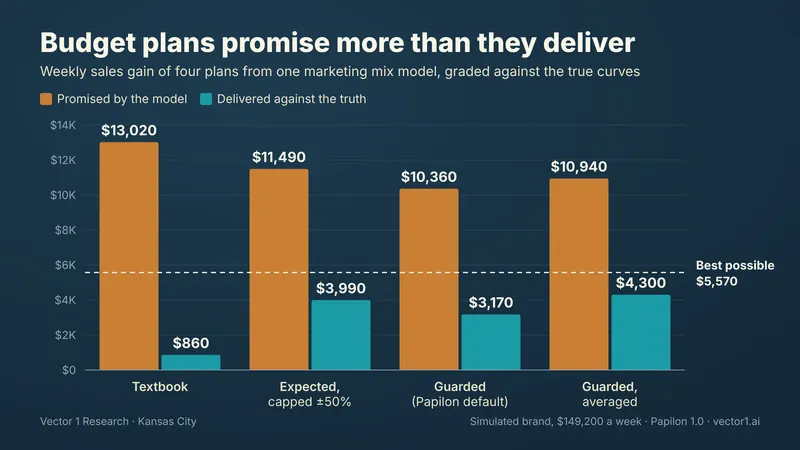
Marketing budget optimization on a brand with a known answer: the textbook plan promised $13,000 a week and delivered $860. Three guards fix it.
Kansas City
Vector 1 is Brian Curry's applied research lab in Kansas City. The same data science problems come up across the metro's industries, from service centers at banks and insurers to health systems, engineering firms and logistics: measuring what marketing actually drove, forecasting demand and capacity, and deciding whether an AI pilot worked. The research here works through those methods with code, tests each one on data where the right answer is known, and publishes the tools as open source.
For inquiries regarding PyCausalSim, Papilon, research citations or technical discussions, reach out directly at [email protected] or connect via GitHub and LinkedIn.
Contact BrianA sourced reference to artificial intelligence in the region: university AI centers, hospital AI, the Google and Meta data centers, Evergy's large-load tariffs and state AI policy. No rankings or paid listings.
See what each marketing channel really returns, with honest uncertainty, and plan a weekly budget against a simulation where the true answer is known.
Open demo →Discover a causal graph from data, see how far the naive correlation is from the real effect of speeding up a page, and ask the model what-if questions in plain English.
Open demo →Three common ways to measure an AI pilot, side by side on data where the true effect is known, and what each one would tell your CFO about ROI.
Open demo →How many months until you can prove an AI use case worked? Sixteen use cases across eight Kansas City industries, with every input editable, plus payback once you count captured savings.
Open demo →Marketing budget optimization on a brand with a known answer: the textbook plan promised $13,000 a week and delivered $860. Three guards fix it.

Papilon 0.5 and PyCausalSim 0.5 let a marketing team write down its assumptions, grade a marketing mix model on brands with known returns, and rank which lift…
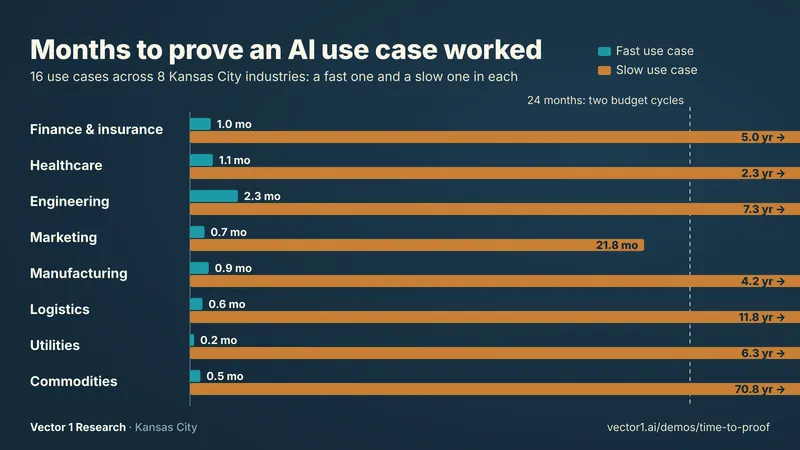
AI ROI by industry turns on four numbers you can estimate before a pilot. A free calculator times 16 Kansas City use cases, from under a month to 71 years.

I ran a cannabis decision engine on two years of a synthetic Missouri dispensary with known answers. It found $293K a year in profit. Graded against the truth,…

I graded a marketing mix model on 120 simulated brands with known returns. Its estimates were honest. Its budget plans lost money for a third of brands, until…

Three common ways to measure an AI pilot, run on the same data, give three different answers. Only one of them separates the tool from the teams who got it and…

The same coding agent gives a data scientist back anywhere from minus 3.5 to plus 11.5 hours a week. The difference is the person directing it. Every…

AI use cases by industry are usually ranked by hype. A better ranking asks how many months it takes to prove a use case worked. Across eight Kansas City…
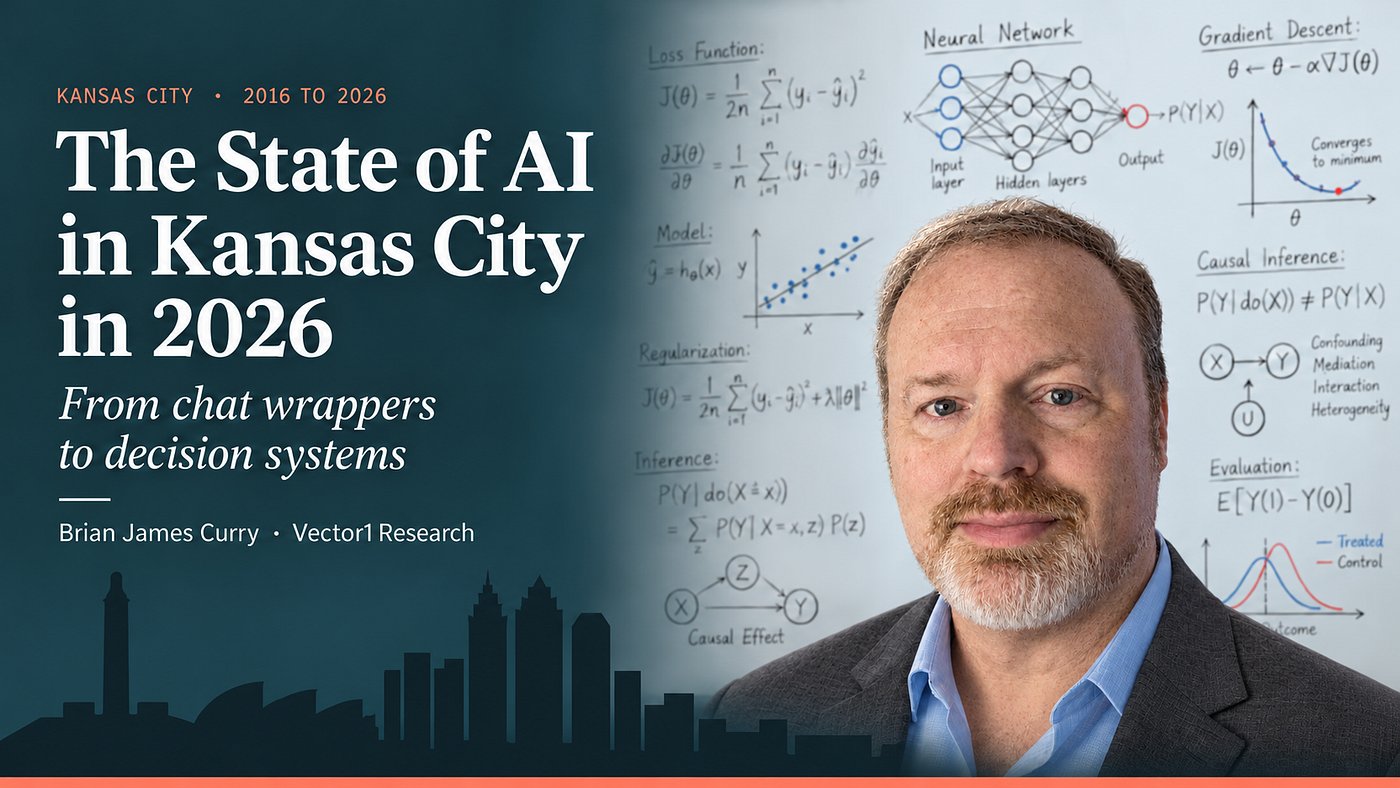
Kansas City’s logistics, manufacturing, agriculture and animal health companies are done paying for chat wrappers. What replaces them, from the founder of KC…
Vector 1 publishes data science research from Kansas City with code and browser demos. Its open-source libraries, Papilon for marketing mix modeling and PyCausalSim for causal discovery and simulation, are on GitHub. KC AI Lab, which Brian Curry founded in 2016, has grown into a local community of more than 1,500 practitioners.
Measurement (what a marketing dollar or a program actually caused), forecasting (demand, capacity and prices) and evaluation (whether a pilot worked against a fair comparison group). High-volume work with fast feedback, such as service centers and route optimization, can be proven in about a month; rare outcomes such as credit losses take years for one organization to prove.
Yes. The demos run in your browser, and the open-source libraries behind much of the research, including Papilon and PyCausalSim, are on GitHub. Questions about the methods or the code are welcome at [email protected].