What Does an AI Consultant Do? Scope, Deliverables and Red Flags
The four kinds of AI consulting work, what each one should hand over at the end, and the warning signs in a proposal.

An AI consultant helps a company decide where AI is worth using, builds or oversees the first working version, and leaves the team able to run it. The title covers very different jobs, so the useful question is which of four kinds of work you are buying, and what should exist when the engagement ends.
The four kinds of AI consulting
| Kind | The question it answers | What you should have at the end |
|---|---|---|
| Strategy and use-case selection | Where does AI pay off first for us? | A ranked list of use cases with an estimated value, cost and time to proof for each |
| Implementation | Can we get one use case working in production? | A working system, its code or configuration, tests, and a runbook your team can follow |
| Evaluation and measurement | Did it work, and is it still working? | A test set, the metrics, the result against a baseline, and a monitoring plan |
| Training and enablement | Can our people use this without the consultant? | People who can do the task alone, plus written guides and examples from your own work |
Most good engagements combine two of these. A strategy engagement with no measurement plan produces a slide deck. An implementation with no enablement produces a system nobody inside can maintain.
What the work looks like week to week
A typical first engagement runs in three stages.
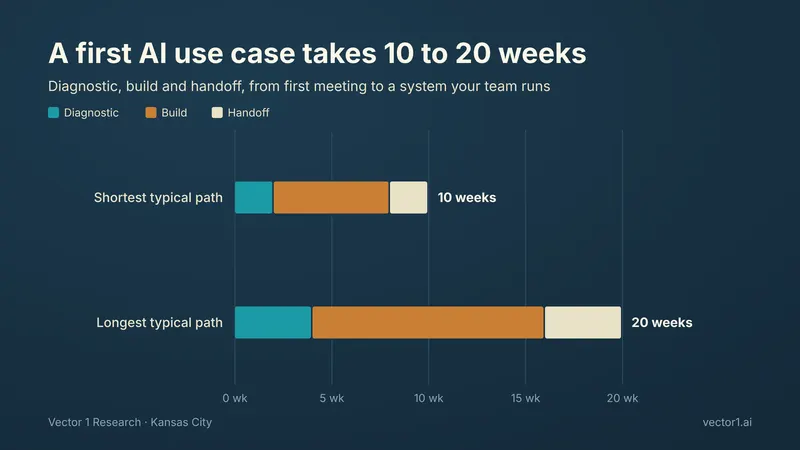
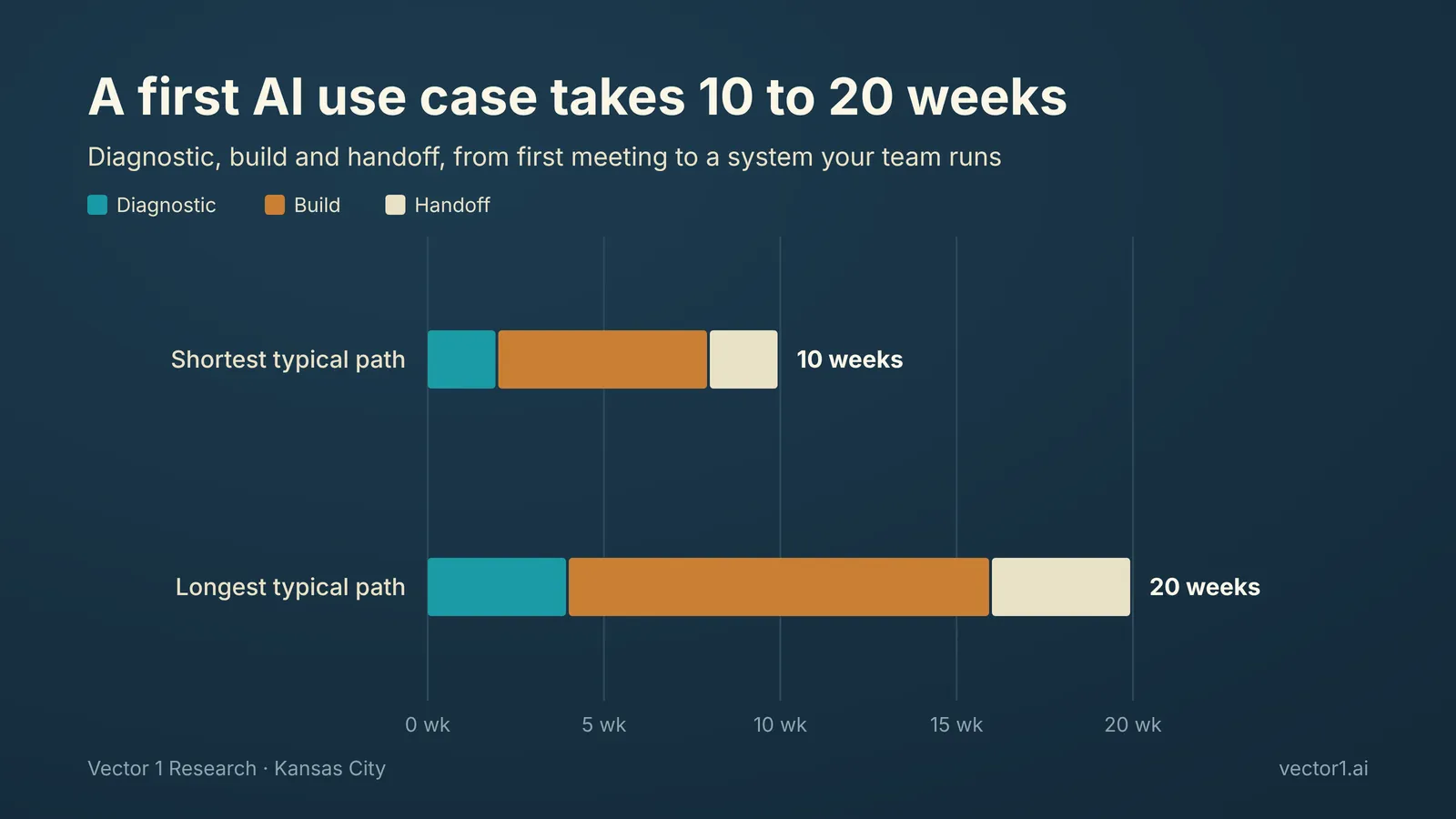
- Diagnostic, 2 to 4 weeks. Interviews, a look at the data and current process, and a short list of candidate use cases. It ends with one recommended use case and a plan.
- Build, 6 to 12 weeks. The first use case built with your team, tested against a baseline, and run in shadow mode beside the current process before anyone relies on it.
- Handoff, 2 to 4 weeks. Documentation, training, and a monitoring plan, so the result survives the consultant leaving.
Putting the ranges together, a first use case usually takes 10 to 20 weeks from first meeting to a system your team runs alone.
Deliverables worth asking for by name
- A baseline. How the task performs today, measured, before any AI is added. Without it, nobody can say whether the result is better.
- A test set. Real examples with known right answers, used to check the system before launch and after every change.
- Review gates. Named points where a person checks the output before it moves on, with what they check written down.
- A cost per task. What each run costs in model and infrastructure spend, so the business case holds at full volume.
- Ownership of the work. The client owns what was built for it. Many consultants keep their pre-existing tools and libraries, which is normal, but the contract should say so.
Red flags in a proposal
- No baseline and no test set, only a demo.
- Success defined as "deploy the model" instead of a business measure such as hours saved or error rate.
- A long build phase with no paid diagnostic first, so the consultant is guessing at scope.
- Tools chosen before the problem is understood.
- No plan for who maintains the system after the engagement.
- Claims of accuracy with no description of how accuracy was measured.
How to check the work afterward
Ask for the test results against the baseline, run on examples the consultant did not tune on. Then pick five recent real cases and compare the system's output with what an experienced person on your team would have done. If the two disagree, find out why before you scale up.
For what this work costs, see How Much Does AI Consulting Cost?, and for choosing someone local, see How to Choose an AI Consultant in Kansas City.