How to Choose an AI Consultant in Kansas City: 12 Questions to Ask
Twelve questions that separate an AI consultant who can deliver from one who can demo, plus a simple scorecard for comparing proposals.

The best way to choose an AI consultant is to ask how they will prove the work succeeded, before you ask what they will build. Strong consultants answer with a baseline, a test and a business measure. Weak ones answer with a tool name. The 12 questions below sort the two, and the scorecard at the end makes proposals comparable.
Why local can matter
For a Kansas City company, a consultant in the metro can run in-person working sessions, sit with the people who do the work today, and come back when something breaks. That helps most for training and change management, where the hard part is people, not code. For a purely technical build, location matters less than evidence of finished work.
The 12 questions
On the problem
- What would you need to see in our data and process before recommending a use case?
- Which of our candidate use cases would you not do, and why?
- How will you measure the task as it runs today, before any AI is added?
On proof
- What will the test set be, and who decides the right answers?
- What result against the baseline would count as failure, and what happens then?
- Can you show a past project's before-and-after numbers, or public work we can inspect?
On delivery
- Who does the work: you, or people we have not met?
- Where are the review gates, and who on our team staffs them?
- What does each run cost at full volume?
On the exit
- What will our team be able to do without you at the end?
- Who owns the code, prompts and configuration?
- What is the smallest paid first step, and what does it produce?
Good answers and weak ones
| Question | A strong answer | A weak answer |
|---|---|---|
| 3. Baseline | "We'll time 50 recent cases and record the error rate first." | "The AI will obviously be faster." |
| 5. Failure | "Below a 20% time saving at the same error rate, we stop and say so." | "It won't fail." |
| 6. Evidence | Named results, open-source code or a demo you can run yourself | A slide of logos |
| 10. Exit | A runbook, trained staff and a monitoring check | "You'll call us when you need changes." |
A scorecard for comparing proposals
Score each proposal 0, 1 or 2 on five factors, then weight them.
| Factor | Weight |
|---|---|
| Clear baseline and test plan | 3 |
| Evidence of finished work | 3 |
| Fit with your actual problem | 2 |
| Plan for your team to run it after | 2 |
| Price for the first step | 1 |
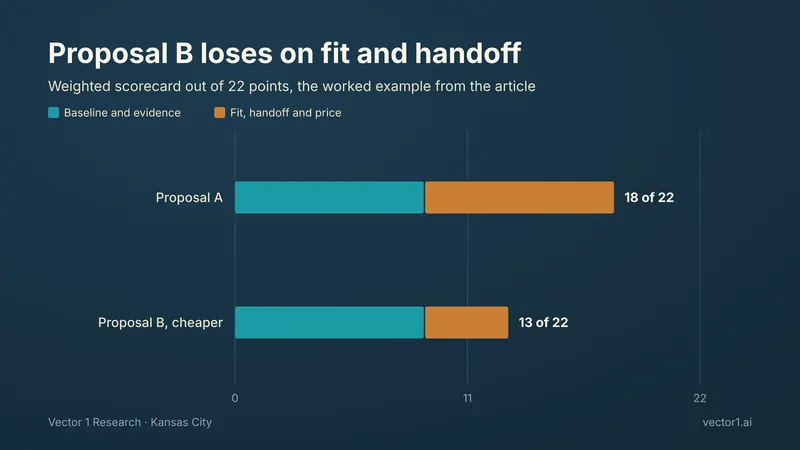
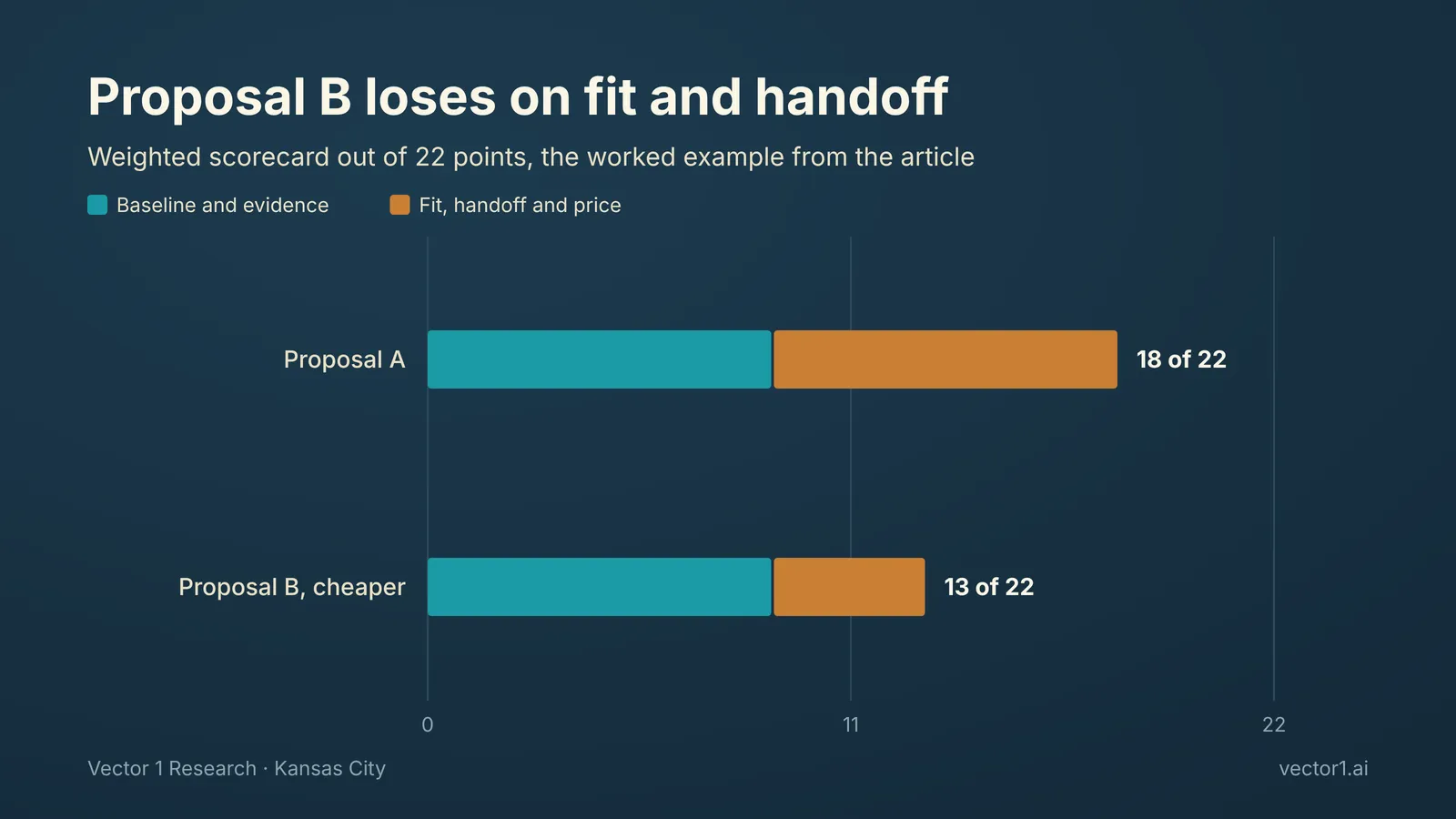
The highest possible score is 2 times 11, which is 22. A worked example: Proposal A scores 2, 1, 2, 2, 1, for 2×3 + 1×3 + 2×2 + 2×2 + 1×1 = 18. Proposal B scores 1, 2, 1, 0, 2, for 1×3 + 2×3 + 1×2 + 0×2 + 2×1 = 13. B is cheaper, but A is far more likely to leave something that works.
Before you sign
Start with a short paid diagnostic, not a large build. Two to four weeks is enough to see how the consultant works with your people and data, and it costs a fraction of a failed build. See What Does an AI Consultant Do? for what each stage should deliver and How Much Does AI Consulting Cost? for budgets.
For the wider picture of AI in the region, see Artificial Intelligence in Kansas City.