Marketing Mix Modeling Consultant or Software? How to Decide
When an open-source library, a software platform or a marketing mix modeling consultant is the right first step, judged on data, team skills and the decision you need to make.

Choose open-source marketing mix modeling if you have an analyst who can run a Bayesian model and check it. Choose a software platform if you want a refreshed model and dashboard without building one. Choose a consultant when the first model has to be right, your team has never built one, or the budget decision is large enough that a wrong answer is expensive. Many teams use a consultant for the first model and a library or platform after that.
The three routes
| Route | What you get | What it needs from you | Best when |
|---|---|---|---|
| Open-source library (Google's Meridian, Meta's Robyn, PyMC-Marketing, Papilon) | Full control and no license fee | An analyst comfortable with Bayesian modeling and validation | You have the skills in house and want to own the method |
| Software platform | A maintained model, refreshes and dashboards | Clean data feeds and someone to own the tool | You need regular updates more than custom methods |
| Consultant | A built and validated first model, a budget plan, and training | Time from your marketing and finance leads | The stakes are high or nobody inside has built an MMM |
Five questions that decide it
1. How much history do you have? Marketing mix models learn from variation over time. Two years of weekly data gives 104 rows to fit every channel, the seasonality and the controls. With eight channels and few weeks, the model leans hard on its priors, and someone has to judge whether those priors are sensible.
2. Who will check the model? A model can fit history well and still be wrong about what each channel caused. Checking it means holdout periods, comparisons with lift tests, and simulated data where the right answer is known. Marketing Mix Modeling You Can Check shows what that looks like.
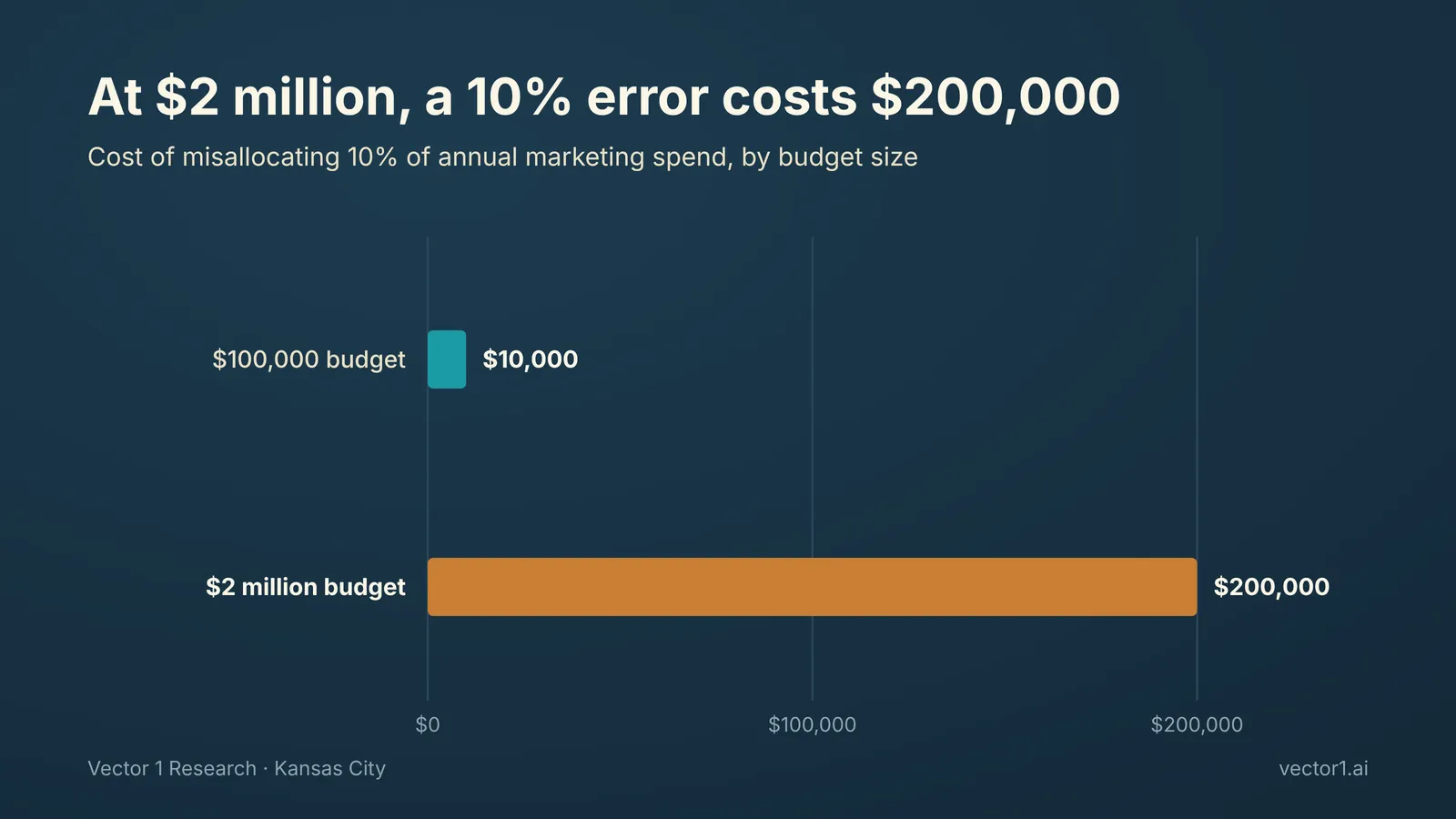
3. What decision rides on it? If the model will move $2 million of annual spend, an error of 10% in where the money goes is $200,000 misallocated. That makes paying for expert validation cheap. If it will move $100,000, a library and a careful analyst are proportionate.
4. How often must it refresh? Platforms are built for regular refreshes. A consultant's model needs a plan for who refreshes it afterward.
5. Do you have lift tests? A model calibrated against even one or two experiments is far more trustworthy than one that only fits history. If you have none, plan one alongside the first model.
A common path that works
- A consultant builds and validates the first model, designs one lift test and trains your analyst. Six to ten weeks.
- Your analyst refreshes it with an open-source library, or you move to a platform once you know what a good model looks like.
- Once a year, an outside review checks the model against new experiments.
This keeps the method in house while getting the first model right.
Try it before you decide
You can fit a marketing mix model to your own weekly spend and sales in the browser with Papilon Studio, free and with no data leaving your computer. Seeing the outputs on your own data, and how uncertain they are, is the fastest way to know which route you need. For turning model output into a budget, see Marketing Budget Optimization with Marginal ROAS.