Who Pays If the Data Center Leaves? A Large-Load Tariff Calculator
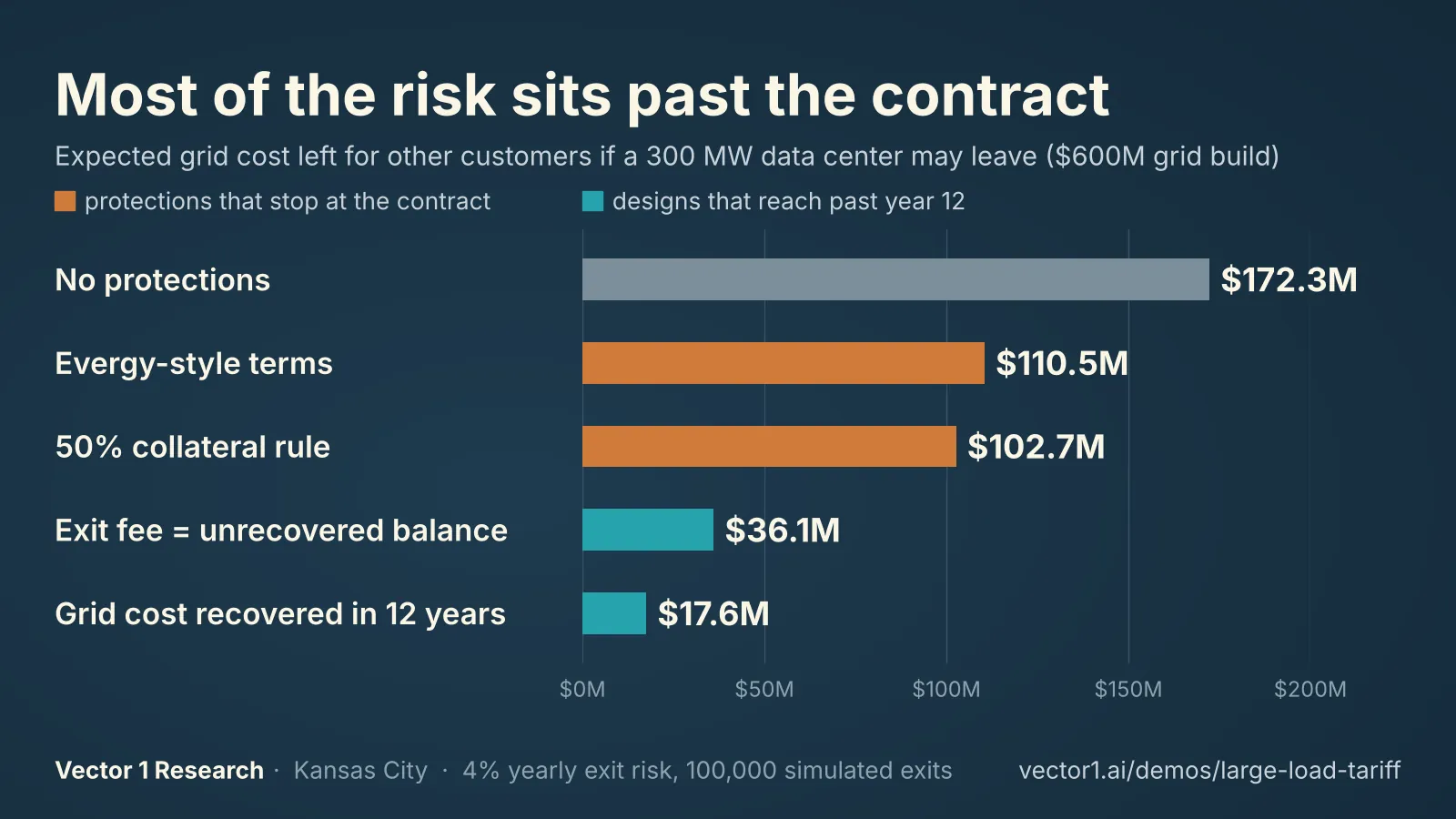
In a model of a 300 MW data center and $600 million of new grid, Evergy-style large-load tariff terms cut the expected cost left for households if it leaves by 36%, from $172.3 million to $110.5 million in 100,000 simulated exits. Most of what remains sits past year 12, and two design changes close most of it.

What a large-load tariff has to protect
A large-load tariff is a utility's answer to one question: if a data center gets a substation, new lines and a share of a new power plant, and then leaves, who pays for what is left? Kansas and Missouri answered it for Evergy in November 2025. Any new load of 75 MW or more signs for at least 12 years, pays a minimum bill on 80% of its contract demand whether it uses the power or not, posts collateral equal to two years of minimum bills, and owes an exit fee if it leaves early.
Those are real protections, and they are shorter than the assets they protect. The calculator assumes the grid built for the site is paid off over 30 years, while the contract runs 12 to 17. I wanted to know how much of the cost the terms keep off household bills, how much they leave, and what it would take to close the rest.
So I ported the large-load tariff calculator to Python and ran it two ways. First, one exit at a time: a data center that leaves after 3, 8, 12 or 20 years, with and without the tariff. Then 100,000 simulated exits under five tariff designs, at three levels of exit risk. The project is illustrative, a 300 MW site and $600 million of grid investment shared by 800,000 other customers, and every number below comes from the code in this article.
What Evergy's large-load tariff says, in both states
The Kansas Corporation Commission approved Evergy's plan on November 6, 2025, and the Missouri Public Service Commission voted a week later, on November 13. The terms match closely:
- Who it covers: new or expanding loads of 75 MW or more.
- Term: at least 12 years, plus an optional ramp of up to 5, for 17 in total.
- Minimum bill: 80% of contract demand, owed regardless of usage (from the Kansas release).
- Collateral: two years of minimum monthly bills.
- Exit fee: in Missouri, the minimum monthly bill times the months left in the term, or 12 months, whichever is greater. Kansas describes it as all the minimum bills that would have been billed.
- Notice: the Missouri agreement renews in five-year periods unless the customer gives at least 36 months' written notice. Less notice adds an early termination fee of twice the minimum monthly bill times the months remaining.
Evergy is not unusual. Researchers at Lawrence Berkeley National Laboratory and the Brattle Group have tracked 264 large-load tariff filings across the country, and in the 55 they analyzed the average minimum contract grew from five years for tariffs proposed before 2025 to 12 years after. AEP Ohio's data center tariff, approved by Ohio regulators in July 2025, uses a different mix: a minimum of 85% of contract capacity, a term of up to four ramp years plus eight, an exit fee of 36 months of minimum charges once the fifth year after the ramp has passed, and collateral of 50% of all minimum charges over the term for customers without strong credit. That collateral rule shows up as one of the designs I test below.
If you want the bill-level story for Kansas City, including Evergy's Missouri rate case, my October piece on Evergy's large-load tariff covers it. This piece is about the exit and the years after the contract.
The model in three formulas
A utility recovers a grid asset like a mortgage: a level annual payment over the asset's life at its cost of capital. For an investment I, a cost of capital r and a life of L years,
With I = $600 million, r = 7.5% and L = 30, that payment is $50.8 million a year. While the data center runs, its demand charges cover A in full.
If it leaves after Y years of a T-year term, it owes an exit fee on the minimum bill, with a 12-month floor:
If it goes bankrupt instead, the utility collects no more than the collateral. Whatever is not recovered is a stranded cost, measured in today's dollars:
Other customers pay S back over the asset's remaining L − Y years. The code is short:
import numpy as np

INV, LIFE, R = 600, 30, 0.075        # $M of grid built, asset life in years, cost of capital
MW, CUSTOMERS = 300, 800_000          # contracted capacity, other customers who share stranded cost

def annuity(pv, r, n):
    return 0.0 if n <= 0 else pv * r / (1 - (1 + r) ** -n)

def pv_level(pay, r, n):
    return 0.0 if n <= 0 else pay * (1 - (1 + r) ** -n) / r

def stranded(Y, bankrupt=False, min_pct=0.0, term=0, coll_months=0,
             coll_share_of_term=None, hold_harmless=False, recover_years=LIFE):
    """Present value ($M, year 0) of grid cost left for other customers
    when the data center leaves after Y years."""
    Y = min(Y, LIFE)
    rr = annuity(INV, R, recover_years)            # demand charges that recover the asset
    paid = pv_level(rr, R, min(Y, recover_years))
    owed = 0.0
    if Y < min(LIFE, recover_years):
        if hold_harmless:                           # exit fee = unrecovered balance
            owed = (INV - paid) * (1 + R) ** Y
        elif term:                                  # minimum bill x months left, at least 12
            owed = rr * min_pct / 12 * max((term - Y) * 12, 12)
    if bankrupt:                                    # only collateral can be collected
        coll = (coll_share_of_term * rr * min_pct * term if coll_share_of_term
                else rr * min_pct / 12 * coll_months)
        owed = min(owed, coll)
    return max(0.0, INV - paid - owed / (1 + R) ** Y)

def household_month(Y, **design):
    """Dollars per other customer per month for the rest of the asset's life."""
    left = LIFE - Y
    S = stranded(Y, **design) * (1 + R) ** Y
    return annuity(S, R, left) * 1e6 / CUSTOMERS / 12 if left > 0 else 0.0

EVERGY = dict(min_pct=0.8, term=12, coll_months=24)

rr = annuity(INV, R, LIFE)
print(f"Revenue requirement: ${rr:.1f}M a year for {LIFE} years")
print(f"Recovered by year 12 at full load: {pv_level(rr, R, 12) / INV:.1%}; "
      f"by year 17: {pv_level(rr, R, 17) / INV:.1%}")
for Y in (3, 5, 8, 10, 12, 13, 17, 20, 25):
    print(Y, round(stranded(Y)), round(stranded(Y, **EVERGY)), round(stranded(Y, True, **EVERGY)),
          f"{household_month(Y):.2f}", f"{household_month(Y, **EVERGY):.2f}")
Revenue requirement: $50.8M a year for 30 years
Recovered by year 12 at full load: 65.5%; by year 17: 79.9%The second line is the whole problem in two numbers. A data center that runs at full contract for all 12 years has paid back 65.5% of the grid built for it, in present value. Stretch to 17 years with a full ramp and it is 79.9%. The tariff's terms can only collect on the contract, so the tail past it falls to whoever is still on the system.
Where the large-load tariff runs out: one exit at a time
Here is the output for a single exit at different years. "Left for others" is the stranded cost in today's dollars; the last two columns spread it across 800,000 customers for the rest of the asset's life.
| Data center leaves after | Left for others, no protections | Left for others, Evergy-style terms | Same terms, but it goes bankrupt | Per household per month, no protections | Per household per month, Evergy-style |
|---|---|---|---|---|---|
| 3 years | $468M | $173M | $402M | $5.29 | $1.96 |
| 5 years | $394M | $196M | $338M | $5.29 | $2.63 |
| 8 years | $302M | $211M | $257M | $5.29 | $3.70 |
| 10 years | $251M | $212M | $212M | $5.29 | $4.46 |
| 12 years | $207M | $190M | $190M | $5.29 | $4.86 |
| 13 years | $187M | $171M | $171M | $5.29 | $4.84 |
| 17 years | $121M | $109M | $109M | $5.29 | $4.77 |
| 20 years | $82M | $73M | $73M | $5.29 | $4.68 |
| 25 years | $34M | $27M | $27M | $5.29 | $4.25 |
An early exit is where the tariff earns its keep: a site that leaves after three years and pays its exit fee leaves $173 million instead of $468 million. After year 8 the protected and unprotected rows converge, because the months left on the term shrink and the 12-month floor is all that remains. And the stranded amount under the tariff barely moves between years 5 and 12. It sits near $200 million because that is roughly the present value of the asset's years 13 to 30, which no exit fee in the contract touches.
The unprotected household cost is a flat $5.29 a month in every row. Without a tariff, the stranded balance at any exit year is exactly the remaining payments on a 30-year schedule, so households simply take over the data center's payment for the years left. The tariff lowers the monthly figure for early exits and leaves it close to $5 for late ones.
Bankruptcy is the other gap. Two years of minimum bills is $81 million of collateral here (0.8 × $50.8 million × 2). A site that fails in year 3 owes a $366 million exit fee, and the collateral covers 22% of it.
Five designs, 100,000 simulated exits
No one knows how often data centers will leave a utility system. There is no public base rate, because the current generation of large AI campuses is too new. So I treated it as an assumption and swept it: an annual exit risk of 2%, 4% or 8%, where a quarter of exits are bankruptcies and the rest give notice and pay what they owe. At 4% a year, 69% of sites leave at some point within the 30-year life; at 2% it is 44% and at 8% it is 91%.
Then I compared five designs:
- No protections.
- Evergy-style terms: 80% minimum bill, 12-year term, 24 months of collateral, the exit fee above.
- The same, with collateral raised to 50% of all minimum charges over the term, the AEP Ohio rule.
- The same, with an exit fee equal to the unrecovered balance of the grid asset, so a solvent customer that leaves at any time pays off what was built for it.
- The same terms, with the grid cost recovered in 12 years instead of 30, so the asset is paid off when the contract ends.
DESIGNS = {
    "No protections": {},
    "Evergy-style terms (80%, 12 yr, 24 mo)": EVERGY,
    "Collateral = 50% of term minimums": dict(EVERGY, coll_months=0, coll_share_of_term=0.5),
    "Exit fee = unrecovered balance": dict(EVERGY, hold_harmless=True),
    "Recover the grid cost in 12 years": dict(EVERGY, recover_years=12),
}

def simulate(hazard, p_bankrupt=0.25, n=100_000, seed=7):
    rng = np.random.default_rng(seed)
    exit_year = rng.geometric(hazard, n)            # year the site leaves (>= LIFE: never)
    bankrupt = rng.random(n) < p_bankrupt
    for name, d in DESIGNS.items():
        s = np.array([stranded(y, b, **d) for y, b in zip(exit_year, bankrupt)])
        print(f"{name:40s} mean ${s.mean():6.1f}M  P(>$100M) {(s > 100).mean():6.1%}"
              f"  per household ${s.mean() * 1e6 / CUSTOMERS:6.2f}")

for h in (0.02, 0.04, 0.08):
    simulate(h)
At 4% a year, the middle case:
| Design | Expected cost left for others | Chance it tops $100M | Per household, present value |
|---|---|---|---|
| No protections | $172.3M | 51.9% | $215.35 |
| Evergy-style terms | $110.5M | 49.9% | $138.19 |
| Collateral = 50% of term minimums | $102.7M | 49.9% | $128.32 |
| Exit fee = unrecovered balance | $36.1M | 11.9% | $45.09 |
| Recover the grid cost in 12 years | $17.6M | 6.1% | $21.96 |
Evergy-style terms cut the expected cost by 36%, from $172.3 million to $110.5 million. What they barely change is the chance of a big loss: 49.9% against 51.9% without any tariff. Exits after year 12 still leave most of the tail behind, and those exits are common when the asset lasts 30 years.
Raising collateral, as the AEP Ohio rule does, only helps with bankruptcies, and here it trims $7.8 million. The two designs that change the picture both deal with the tail. An exit fee set to the unrecovered balance drops the expected cost to $36.1 million, and every dollar of what remains comes from bankrupt sites whose collateral ran out. Recovering the grid cost within the contract term drops it to $17.6 million.
The ordering holds at the other risk levels:
| Annual exit risk | No protections | Evergy-style | 50% collateral | Unrecovered-balance exit fee | 12-year recovery |
|---|---|---|---|---|---|
| 2% | $97.8M | $64.7M | $60.5M | $20.4M | $9.3M |
| 4% | $172.3M | $110.5M | $102.7M | $36.1M | $17.6M |
| 8% | $274.8M | $166.6M | $152.4M | $58.0M | $31.9M |
What closing the gap costs the data center
Neither fix is free, and the second one shows the price most plainly. Recovering $600 million in 12 years instead of 30 raises the annual payment from $50.8 million to $77.6 million, 53% more, while the contract runs:
rr12 = annuity(INV, R, 12)
print(f"Demand charge: ${rr:.1f}M a year over 30 years, ${rr12:.1f}M over 12 (+{rr12 / rr - 1:.0%})")
print(f"Per kW-month at {MW} MW: ${rr * 1e6 / (MW * 1000) / 12:.2f} vs ${rr12 * 1e6 / (MW * 1000) / 12:.2f}")
Demand charge: $50.8M a year over 30 years, $77.6M over 12 (+53%)
Per kW-month at 300 MW: $14.11 vs $21.55For a 300 MW site that is the difference between $14.11 and $21.55 per kilowatt-month for the grid it needed, before energy, generation capacity and everything else on the bill. Whether developers would accept that, or build somewhere else, is a judgment for regulators, and the model cannot make it.
The unrecovered-balance exit fee leaves the monthly rate alone and moves the risk to the moment of exit. Its weakness is the same one the model shows for every design: it only works on a customer that can pay. The 25% of exits I assumed to be bankruptcies are where the remaining $36.1 million comes from, which is why collateral and credit rules still matter alongside it.
What the model leaves out
The model is built to isolate one risk, and it ignores several things that would lower the cost in practice.
- Backfill. If another large customer takes the capacity, the stranded cost shrinks or vanishes. The model assumes no one does, so it overstates the cost wherever a replacement is waiting in year 14.
- Ramp and renewal. I start the 12 years at year 0 and ignore the five-year ramp, which lengthens the protected period. The Missouri agreement also renews in five-year blocks unless the customer gives 36 months' notice, so a customer that forgets to give notice keeps paying.
- Early termination. Missouri's extra fee of twice the minimum bill for short notice is not modeled. It raises collections from solvent customers that leave in a hurry.
- The minimum bill itself. I size demand charges to recover the grid asset alone. A real minimum bill covers 80% of contract demand at tariff rates that include generation and other costs, so the fee it produces will differ.
- Energy margins and load growth. Neither is in the model, and both affect what households pay.
The exit risk is also an assumption, not a forecast. The useful result is the ordering, which does not change across a fourfold range of risk: tariffs that stop at the contract leave most of the tail, and the designs that close it either recover the asset within the contract or price the exit at the balance still owed.
Run it with your own numbers
The large-load tariff calculator runs the same model in your browser. Set the investment, the asset life, the minimum bill, the term and the year the data center leaves, and switch between a clean exit and a bankruptcy to watch the gap open and close. For a Kansas City utility watching data center demand climb, the most useful inputs to change are the asset life and the cost of capital, since they decide how much of the tail sits beyond any contract.
More of this work is in the energy and grid economics research hub and the Kansas City research hub.
Sources
- Kansas Corporation Commission, KCC approves new power rate plan for large energy users, November 6, 2025
- Missouri Public Service Commission, PSC approves Evergy Large Load Power Service plan with customer protections, November 14, 2025
- KCUR, Missouri will require data centers to pay their fair share, November 14, 2025
- Brian Martucci, Large-load tariffs review by LBNL and Brattle, Utility Dive, September 8, 2026
- AEP Ohio, Data center tariff