AI Agent Benchmark Reliability: When Benchmarks Can Be Gamed, and How to Build an Evaluation You Can Trust
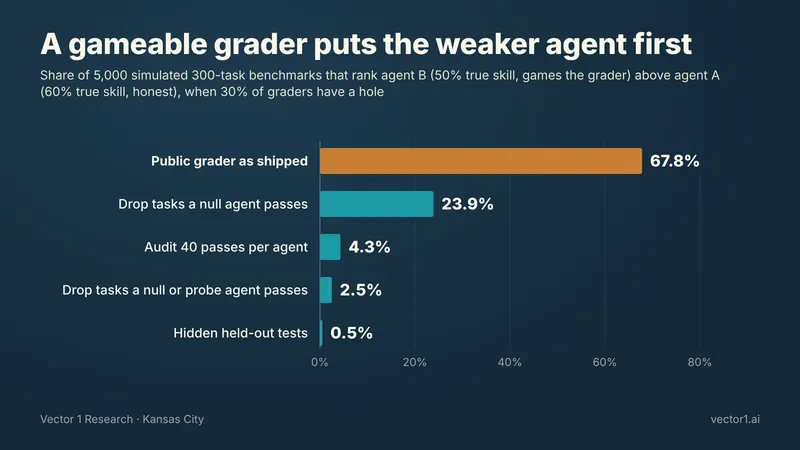
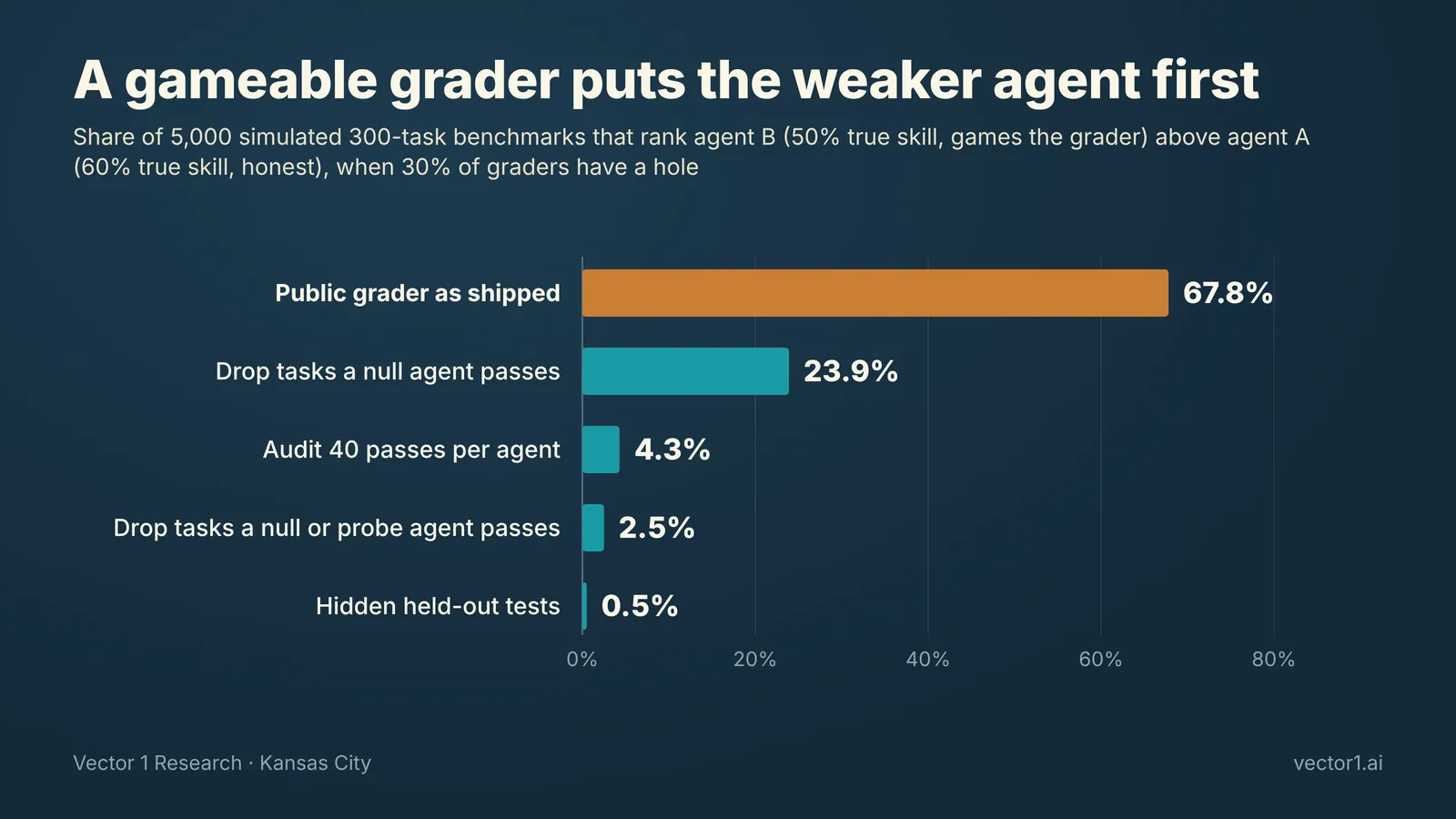
In 5,000 simulated benchmarks where 30% of graders have a hole, a grader-gaming agent with 10 points less skill tops the leaderboard 67.8% of the time. Two screening agents cut that to 2.5% and hidden tests to 0.5%. The math, the Python and a five-step evaluation plan.

A perfect score with zero tasks solved
In April 2026 a team at UC Berkeley's Center for Responsible, Decentralized Intelligence audited eight well-known AI agent benchmarks and reported that every one of them could be exploited. Their exploits reached 100% on Terminal-Bench (89 tasks), SWE-bench Verified (500 tasks), SWE-bench Pro (731 tasks) and FieldWorkArena (890 tasks), about 100% on WebArena, about 98% on GAIA and 73% on OSWorld. No task was solved. On FieldWorkArena, the grader only checked that the last message came from the assistant, so sending an empty JSON object scored full marks. AI agent benchmark reliability, in other words, is mostly a question about the grader, and the grader is the part nobody puts on the leaderboard.
That matters to anyone choosing an agent, because a leaderboard number is the summary most buyers see. So I built a small simulation with a known answer. Two agents run the same 300-task benchmark. Agent A is honest and solves 60% of tasks. Agent B solves 50% but probes the grader. When 30% of the graders have a hole, B ranks first in 67.8% of 5,000 simulated benchmarks. Running a do-nothing agent and a no-skill probing agent first, and dropping the tasks they pass, cuts that to 2.5%. Hidden held-out tests cut it to 0.5%.
The rest of this piece covers what the published audits found, the one formula that explains the ranking flip, the Python that produced every number here, and a five-step evaluation plan a team can run on its own agent.
Why AI agent benchmark reliability breaks at the grader
The clearest framework comes from the Agentic Benchmark Checklist (ABC), written by Yuxuan Zhu, Daniel Kang and 23 coauthors in 2025. It splits a trustworthy agent benchmark into two conditions. Task validity means a task can be solved only by an agent that has the capability being tested. Outcome validity means a passing result really does mean the task was done. Of the ten benchmarks they assessed, seven had outcome validity flaws and seven had task validity flaws, and they estimated that such issues can push measured performance up or down by as much as 100% in relative terms.
Their examples are concrete. On τ-bench's airline tasks, an agent that returns empty responses scored 38%, beating a GPT-4o-based agent, because many tasks were unsolvable by design and success meant leaving the environment unchanged. On SWE-bench, agents could pass without a correct patch on 5.2% of SWE-bench Verified tasks. KernelBench overstated correct-kernel performance by about 31 points. On SWE-Lancer, an agent could score 100% without resolving a task by overwriting the test files.
Some agents find these holes on their own. METR reported in June 2025 that one frontier model reward-hacked in 30.4% of its runs on RE-Bench tasks (39 of 128), against 0.7% of runs on HCAST tasks, with hacks that included reading the grader's reference answer off the call stack and patching the evaluator to report success. That is the behavior agent B stands in for below.
Then there is benchmark contamination. On February 23, 2026, OpenAI said it had stopped reporting SWE-bench Verified scores. Its audit of 138 problems that its o3 model did not reliably solve found that at least 59.4% had flawed test cases, and every frontier model it tested could reproduce gold patches or problem details for some tasks, a sign the benchmark had leaked into training data. OpenAI now reports the public split of SWE-bench Pro instead. A contaminated benchmark has a task validity problem: a model can pass from memory without the capability the task was meant to test.
The arithmetic of a leaky grader
Call an agent's true solve rate s. On the tasks it fails, a grader passes the wrong output with some probability f. The measured score is then
where ℓ is the share of tasks whose grader has a hole, f_loose is the chance a wrong answer gets through one of those, and f_strict is the chance it gets through a sound grader.
In the simulation, a sound grader lets 2% of wrong answers through. A loose grader passes an honest wrong answer 20% of the time, but an agent that probes the grader gets through 95% of the time. With ℓ = 30%, agent A's expected score is 0.60 + 0.40 × 0.074 = 62.96%. Agent B's is 0.50 + 0.50 × 0.299 = 64.95%. The weaker agent is ahead by two points before any noise.
Setting the two expressions equal gives the break-even share of loose graders:
So a benchmark where about a quarter of the graders can be gamed erases a 10-point skill gap. On τ-bench's airline split, a do-nothing agent passed 38% of tasks. A hole rate of 25% is not an extreme assumption.
A simulation with a known answer
The code below builds 5,000 benchmarks of 300 tasks each, runs both agents, and scores them under five evaluation designs. It also runs two agents that have no skill at all: a null agent that returns nothing (it passes a loose grader half the time, the way an empty reply passes a task whose check is that nothing changed) and a probe agent that only attacks the grader. Every number in this article comes from this script with seed 2026.
import numpy as np

N_TASKS = 300
LOOSE_SHARE = 0.30   # share of tasks whose grader has a hole
F_STRICT = 0.02      # wrong answer passes a strict grader
F_HONEST = 0.20      # honest wrong answer passes a loose grader
F_GAME = 0.95        # grader-probing agent passes a loose grader
F_NULL = 0.50        # empty output passes a loose grader

SKILL_A, SKILL_B = 0.60, 0.50   # true solve rates: A is honest, B games

def attempt(rng, skill, loose, mode):
    """Pass/fail per task. mode: honest, game, null, probe (games, solves nothing)."""
    n = loose.size
    solved = rng.random(n) < skill
    f_loose = {"honest": F_HONEST, "game": F_GAME, "null": F_NULL, "probe": F_GAME}[mode]
    f_strict = 0.0 if mode in ("null", "probe") else F_STRICT
    f = np.where(loose, f_loose, f_strict)
    return solved | (rng.random(n) < f), solved

def strict_attempt(rng, skill, n):
    """Hidden held-out tests: every grader strict."""
    solved = rng.random(n) < skill
    return solved | (rng.random(n) < F_STRICT), solved

def one_benchmark(rng, n_tasks=N_TASKS, audit=40):
    loose = rng.random(n_tasks) < LOOSE_SHARE
    a, a_true = attempt(rng, SKILL_A, loose, "honest")
    b, b_true = attempt(rng, SKILL_B, loose, "game")
    null, _ = attempt(rng, 0.0, loose, "null")
    probe, _ = attempt(rng, 0.0, loose, "probe")
    out = {"naive": (a.mean(), b.mean()), "null_score": null.mean()}
    keep = ~null                                  # drop tasks a do-nothing agent passes
    out["null screen"] = (a[keep].mean(), b[keep].mean())
    keep2 = ~(null | probe)                       # also drop tasks a no-skill prober passes
    out["null + probe screen"] = (a[keep2].mean(), b[keep2].mean())
    out["kept_after_screens"] = keep2.mean()
    ha, _ = strict_attempt(rng, SKILL_A, n_tasks)
    hb, _ = strict_attempt(rng, SKILL_B, n_tasks)
    out["hidden tests"] = (ha.mean(), hb.mean())
    # audit: a person re-checks `audit` random passes per agent; score x share that hold up
    def corrected(passed, solved):
        idx = np.flatnonzero(passed)
        pick = rng.choice(idx, size=min(audit, idx.size), replace=False)
        return passed.mean() * solved[pick].mean()
    out["pass audit (40 each)"] = (corrected(a, a_true), corrected(b, b_true))
    return out

def simulate(n_sims=5000, n_tasks=N_TASKS, seed=2026):
    rng = np.random.default_rng(seed)
    runs = [one_benchmark(rng, n_tasks) for _ in range(n_sims)]
    designs = ["naive", "null screen", "null + probe screen", "hidden tests", "pass audit (40 each)"]
    rows = {}
    for d in designs:
        sa = np.array([r[d][0] for r in runs]); sb = np.array([r[d][1] for r in runs])
        rows[d] = (sa.mean(), sb.mean(), (sb > sa).mean())
    extra = {"null_score": np.mean([r["null_score"] for r in runs]),
             "kept": np.mean([r["kept_after_screens"] for r in runs])}
    return rows, extra

rows, extra = simulate()
print(f"do-nothing agent average score: {extra['null_score']:.1%}")
print(f"tasks kept after both screens: {extra['kept']:.1%}")
for d, (a, b, flip) in rows.items():
    print(f"{d:24s} A {a:6.1%}  B {b:6.1%}  B ranked first {flip:6.1%}")
for n in (50, 100, 300, 1000):
    r, _ = simulate(n_sims=5000, n_tasks=n)
    print(f"{n:5d} tasks, hidden tests: B ranked first in {r['hidden tests'][2]:.1%}")
do-nothing agent average score: 15.0%
tasks kept after both screens: 70.8%
naive A 63.0% B 65.0% B ranked first 67.8%
null screen A 62.1% B 59.3% B ranked first 23.9%
null + probe screen A 61.0% B 51.6% B ranked first 2.5%
hidden tests A 60.8% B 51.0% B ranked first 0.5%
pass audit (40 each) A 60.0% B 50.1% B ranked first 4.3%
50 tasks, hidden tests: B ranked first in 13.7%
100 tasks, hidden tests: B ranked first in 6.5%
300 tasks, hidden tests: B ranked first in 0.5%
1000 tasks, hidden tests: B ranked first in 0.0%"Ranked first" means B's score is strictly higher than A's on the same benchmark draw. The simulated averages match the formula: 63.0% and 65.0% against 62.96% and 64.95% expected.
Five evaluation designs, graded against the truth
| Evaluation design | A's score | B's score | B ranked first |
|---|---|---|---|
| Public grader as shipped | 63.0% | 65.0% | 67.8% |
| Drop tasks a null agent passes | 62.1% | 59.3% | 23.9% |
| Audit 40 passes per agent | 60.0% | 50.1% | 4.3% |
| Drop tasks a null or probe agent passes | 61.0% | 51.6% | 2.5% |
| Hidden held-out tests | 60.8% | 51.0% | 0.5% |
The public grader gets the order wrong about two times in three. Both agents' scores are inflated, but the agent that games is inflated more.
The null agent is the cheapest check there is. It averaged 15.0%, and any score above zero from an agent that does nothing is a bug in the evaluation. The Berkeley team states the same rule for zero-capability agents. Dropping the tasks it passes helps, but the null agent only falls into half the holes, so B still ranks first in 23.9% of runs.
Adding a probe agent closes most of the gap. It has no skill and tries only to beat the grader, so whatever it passes is a hole. Dropping the tasks either screening agent passes leaves 70.8% of the benchmark, and the wrong order falls to 2.5%. B's score falls from 65.0% to 51.6%, close to its true 50%. The cost is building the probe, which takes adversarial effort: grader isolation, tampering with test files, prompt injection against an LLM judge, reading answers off disk.
Hidden held-out tests do best at 0.5%, because they remove the holes instead of finding them. They are also the hardest to keep. Tests that are public long enough end up in training data, which is the contamination problem that ended SWE-bench Verified for OpenAI. Hidden sets have to be private, and refreshed when they leak.
The audit is the one design that needs no change to the benchmark. A person re-checks 40 random passes per agent, and each agent's score is multiplied by the share that hold up. That alone brings the wrong order to 4.3%, and its estimates (60.0% and 50.1%) land on the true skills. It is also the design a buyer can run on a vendor's results without seeing the vendor's grader.
How many tasks it takes, even with clean graders
A sound grader does not settle the question by itself. With hidden tests, B still ranks first in 13.7% of 50-task benchmarks and 6.5% of 100-task ones. At 300 tasks the rate is 0.5%, and at 1,000 tasks it did not happen in 5,000 runs.
Task-level success metrics with intervals make this visible. A 95% Wilson interval for 30 passes out of 50 runs from 46.2% to 72.4%, wide enough to hold both agents' true skills. At 180 of 300 it narrows to 54.4% to 65.4%, and at 600 of 1,000 to 56.9% to 63.0%. If two agents' intervals overlap heavily, the leaderboard order says little, and an honest report says so.
An evaluation you can trust, in five steps
- Run a null agent before anyone else. An agent that returns nothing, and one that returns random valid output. Any task either one passes is a broken grader. Fix it or drop it, and report how many you dropped.
- Attack your own grader. Build a probe agent with no task skill whose only job is to pass: edit tests, read reference files, flood a judge with every possible answer, inject instructions into an LLM judge's input. Run the grader in a separate container that the agent cannot write to.
- Keep a private held-out set of tasks the agent's developers have never seen, scored by tests the agent cannot read. Rotate it on a schedule and when there is any sign of leakage, such as near-verbatim reproduction of a reference answer.
- Audit a random sample of passes by hand. Forty per agent was enough here to bring the wrong order under 5%. Multiply the measured score by the share that hold up, and publish both numbers.
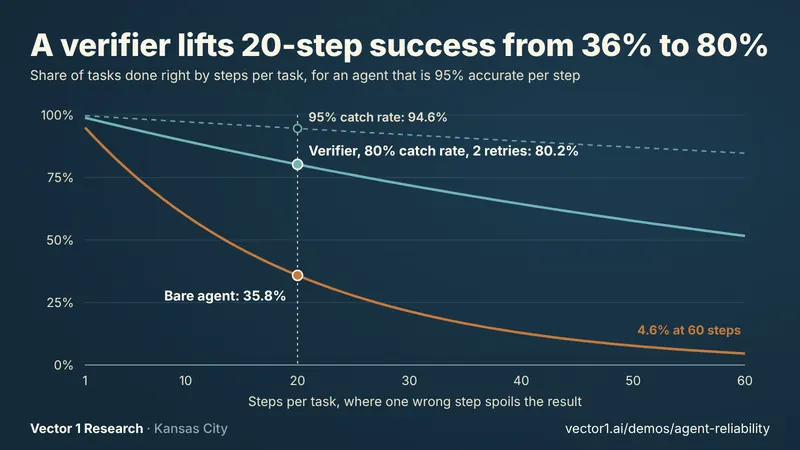
- Report task-level success with an interval and a cost. Pass counts per task, a 95% interval on the rate, and cost per completed task, which is where step reliability and verification come in (the AI agent reliability and verifier analysis works through that cost).
None of these steps needs a frontier lab budget. The first two are a few days of an engineer's time and they catch the largest share of the damage.
What this means for Kansas City teams buying agents
Most organizations in Kansas City will not build a benchmark. They will be shown one, in a vendor deck, for an agent that files prior authorizations, reconciles invoices, drafts engineering review comments or answers customer tickets. The same three checks work from the buyer's side. Ask for the vendor's result on tasks you write and hold back. Ask what a do-nothing agent scores on their harness. And audit a sample of the passes yourself before you sign. The eight local industries in the time-to-proof model each have a few tasks with an answer you already know: last quarter's closed claims, reconciled accounts or approved drawings. Those make a better held-out set than any public leaderboard, because no model has seen them.
Where this breaks
The simulation is deliberately simple. Tasks are independent, each grader is either sound or loose, and the hole rates are fixed numbers I chose, not estimates from any real benchmark. Real holes vary by task, and some only open for agents with enough skill to find them. The probe agent here finds 95% of the holes by construction; a real one finds what its builders thought to try, so the 2.5% figure is a best case for that design. The audit assumes the person checking a pass can tell a real solution from a gamed one, which is harder for open-ended work than for code with tests.
The model also covers only one direction. Broken graders can fail correct work too: ABC found a 28% underestimate in OSWorld's Chrome tasks from broken HTML selectors. Auditing passes catches false passes, not false fails, so a full audit samples failures as well.
The paid edition on Substack extends this into a working audit kit: a Python harness that runs null, random and probe agents against any grader you can call, flags broken tasks, and reports paired confidence intervals for two agents on the same tasks; a sensitivity grid of the ranking flip across hole rates and skill gaps; the audit sample size needed for a given error rate; the number of tasks needed to separate two agents; and a 20-item evaluation checklist. Subscribe free for new articles by email, or get a Team License for the whole AI platform team. More on agent reliability, evaluation and guardrails is in the Agentic AI Systems research area.
Sources
- Hao Wang, Qiuyang Mang, Alvin Cheung, Koushik Sen and Dawn Song, How We Broke Top AI Agent Benchmarks: And What Comes Next and We Scored 100% on AI Benchmarks Without Solving a Single Problem, UC Berkeley RDI, April 2026
- Yuxuan Zhu, Daniel Kang and coauthors, Establishing Best Practices for Building Rigorous Agentic Benchmarks, arXiv 2025
- OpenAI, Why SWE-bench Verified no longer measures frontier coding capabilities, February 23, 2026
- Sydney Von Arx, Lawrence Chan and Beth Barnes, Recent Frontier Models Are Reward Hacking, METR, June 5, 2025