Why a 95%-Accurate AI Agent Fails Most 20-Step Tasks, and What a Verifier Buys You
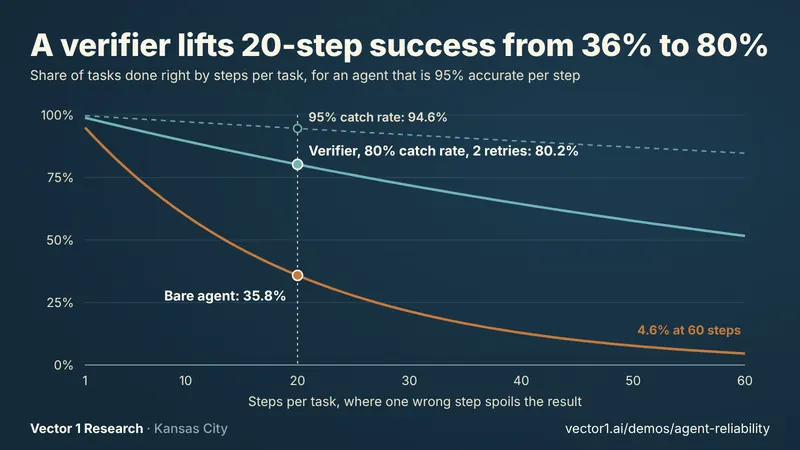
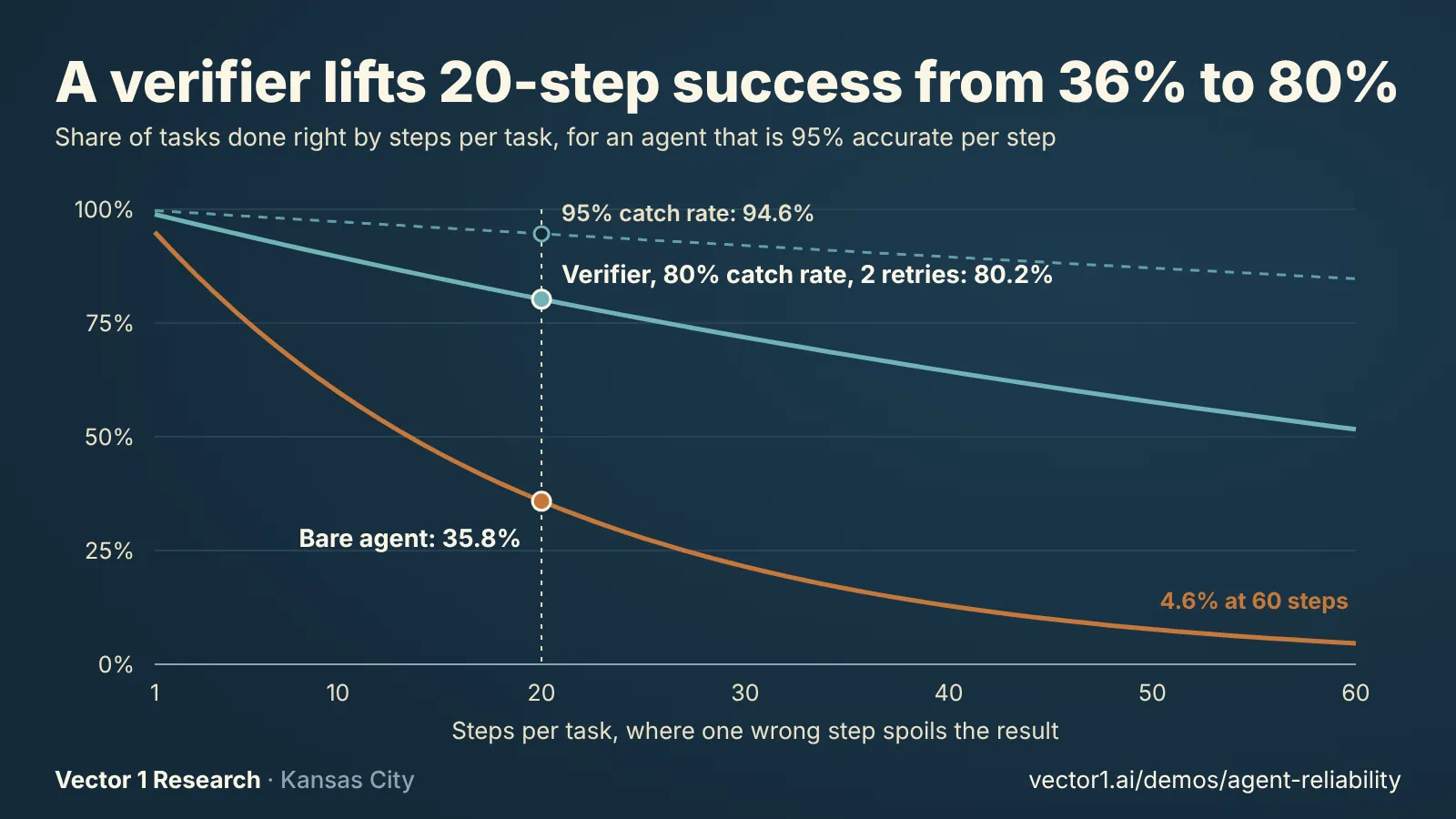
AI agent reliability compounds. A 95%-accurate agent finishes 35.8% of 20-step tasks; a step verifier lifts it to 80.2% and cuts cost per correct task.

AI agent reliability is a multiplication problem
A model that gets each step right 95% of the time sounds ready for work. Give it a task with 20 steps, where any wrong step spoils the result, and AI agent reliability turns into multiplication: 0.95 multiplied by itself 20 times is 0.358. The agent finishes about 36 tasks in 100 correctly. The other 64 come back wrong, and nothing in the output says which ones.
That arithmetic explains a lot of disappointing pilots. Gartner expects more than 40% of agentic AI projects to be canceled by the end of 2027, citing rising costs and unclear business value. A demo usually runs a short task once. Production runs long tasks thousands of times, and every added step multiplies in another chance to fail.
The fix is a design choice more than a model choice. Check each step with a verifier, retry what it flags, and send a step to a person when the retries run out. With the defaults below, that lifts the same 95% agent from 35.8% to 80.2% of tasks done right, and it lowers the cost per correct task even though it nearly doubles what the agent spends.
This piece gives the formulas, Python that runs as written (with a simulation that checks the closed form), the levers that matter and the one that mostly doesn't, and where the model is too kind to real agents. Every number can be reproduced in the free agent reliability calculator, which runs in your browser.
Video transcript
Why a 95% accurate agent fails most long tasks. One step at 95% is right 95% of the time, but twenty steps at 95% each finish only 35.8% of tasks: 0.95 to the 20th power is 0.358. About 64 of 100 twenty-step tasks come back wrong, and nothing in the output says which.
The bar is higher than it looks. To finish 90% of tasks, every step has to be right 99.47% of the time at 20 steps and 99.79% at 50. METR found the task length agents finish with 80% reliability is about five times shorter than the length they finish half the time.
What a verifier does: check, retry, escalate. Each agent step goes to a verifier that catches 80% of bad steps. A step that passes moves on; a flagged step is retried up to two times, then a person fixes it. Same 95% agent, same 20 steps: tasks done right go from 35.8% to 80.2%.
Retries buy cost. The catch rate buys reliability. With an 80% catch rate, two retries give 80.2% and unlimited retries still give 80.2%. A 95% catch rate with two retries gives 94.6%. Past two retries, success barely moves; the verifier's misses set the ceiling.
More per run, less per result. All-in cost per task, with failed tasks redone by hand: $40.00 to do every task by hand, $26.06 for the bare agent, $8.64 with the verifier. The verifier raises agent spend from $0.40 to $0.74 a task and cuts cost per correct task from $1.12 to $0.92.
Where the model is too kind. Without a final review, the bare agent ships about 64 wrong results per 100 tasks and the verified agent about 20. Real errors cluster and retries repeat mistakes. A model grading its own work is the weakest check; seed known errors and count what it flags.
Know your success rate before you scale. Try the agent reliability calculator at vector1.ai/demos/agent-reliability. It is free, runs in your browser, and takes your steps, accuracy, verifier and costs. The full article and Python are on vector1.ai.
The compounding formula
If each step succeeds with probability p, independently, and a task needs all k steps right, the task succeeds with probability
Turn it around to ask what per-step accuracy a target success rate needs:
| Per-step accuracy | 5 steps | 10 steps | 20 steps | 50 steps | 100 steps |
|---|---|---|---|---|---|
| 90% | 59.0% | 34.9% | 12.2% | 0.5% | 0.0% |
| 95% | 77.4% | 59.9% | 35.8% | 7.7% | 0.6% |
| 99% | 95.1% | 90.4% | 81.8% | 60.5% | 36.6% |
| 99.9% | 99.5% | 99.0% | 98.0% | 95.1% | 90.5% |
To finish 90% of 20-step tasks, every step has to be right 99.47% of the time. At 50 steps the bar is 99.79%. Each extra nine of per-step accuracy buys roughly ten times the task length at the same success rate, which is why long tasks reward reliability far more than they reward a slightly smarter model.
Measured agents show the same shape. METR's 2025 study of how long a task frontier models can finish found that the length they complete with 80% reliability is about five times shorter than the length they complete half the time; for Claude 3.7 Sonnet, about 15 minutes against 59. If every step had the same constant accuracy, the formula above predicts a ratio of ln(0.5)/ln(0.8), about 3.1. The measured gap is wider than the simple model, so treat p^k as a floor on how fast reliability falls with length, not a pessimistic case.
Consistency points the same way. On τ-bench, a customer service benchmark, the authors reported that GPT-4o solved fewer than half the tasks and that the chance of solving the same retail task in all 8 of 8 tries fell below 25%. A 2026 study by Rabanser, Kapoor, Narayanan and colleagues tested 14 models from OpenAI, Google and Anthropic and found outcome consistency across repeated runs of 30% to 75%, with reliability improving only modestly over 18 months while accuracy rose substantially.
What a verifier does to one step
A verifier is anything that checks a step before the next one builds on it: a second model call, a unit test, a schema check, a reconciliation against a source system, a rule. Describe it with two numbers. The catch rate c is the share of bad steps it flags. The false-flag rate f is the share of good steps it flags anyway.
Each attempt is flagged with probability
A flagged step is retried, up to R retries. If every attempt is flagged, the step goes to a person, who fixes it at cost h. A step ends right if some attempt is good and passes, or if it is escalated and fixed:
A step ends silently wrong when a bad attempt slips past the verifier:
With p = 0.95, c = 0.80, f = 0.05 and R = 2, an attempt is flagged 8.75% of the time, the silent error per step falls from 5% to 1.10%, and task success over 20 steps rises from 35.8% to 80.2%.
The bound on the right is the ceiling, and it holds no matter how many retries you allow. With these numbers it is 1.096% per step, so even unlimited retries leave task success at 80.2%. The verifier's misses set the reliability. Retries mostly set the cost.
Retries buy cost; the catch rate buys reliability
Holding everything else at the defaults, here is what each lever does to a 20-step task.
| Retries before escalating | Tasks done right | Agent spend per task | Cost per correct task | Escalations per 100 tasks |
|---|---|---|---|---|
| 0 | 81.8% | $11.10 | $13.57 | 175 |
| 1 | 80.4% | $1.57 | $1.96 | 15.3 |
| 2 | 80.2% | $0.74 | $0.92 | 1.3 |
| 5 | 80.2% | $0.66 | $0.82 | 0.0 |
With no retries, every flagged step goes straight to a person: 175 escalations per 100 tasks at $6 each. Success is slightly higher only because the person always gets the step right, while a retry is one more chance for a bad attempt to slip through. Two retries cut escalations to about one per 100 tasks, and past that, retries change almost nothing.
| Verifier catch rate | Silent error per step | Tasks done right | Cost per correct task |
|---|---|---|---|
| 50% | 2.69% | 57.9% | $1.20 |
| 80% | 1.10% | 80.2% | $0.92 |
| 90% | 0.55% | 89.5% | $0.84 |
| 95% | 0.28% | 94.6% | $0.81 |
| 99% | 0.06% | 98.9% | $0.78 |
Moving the catch rate from 80% to 95% takes task success from 80.2% to 94.6%. No amount of retrying gets there. If you have budget to improve one thing, improve what the verifier catches.
Agent verification and the cost per completed task
The usual way to price an agent is cost per run: tokens in, tokens out. That number rewards the cheapest setup, which is also the least reliable one. The number that matters to the business is what it costs to get one task done right.
Agent spend per task is k times the expected attempts per step, times the cost of an attempt and its check, plus the expected cost of escalated steps. Divide by the success rate:
At $0.02 a step attempt and $0.01 a check, the bare agent spends $0.40 a task and the verified agent $0.74. Per correct task the order flips: $1.12 for the bare agent, $0.92 with the verifier. The verifier costs more per run and less per result.
Most teams also need the failed tasks done, not just counted. If a final review catches every failed task and a person redoes it for $40, the all-in cost per task is
That is $26.06 for the bare agent and $8.64 with the verifier, against $40.00 for doing every task by hand. The bare agent saves 35%; the verified agent saves 78%.
Task length moves the answer. At 10 steps the bare agent's cost per correct task ($0.33) beats the verified agent's ($0.41), because there is less to compound, but the all-in cost still favors the verifier, $4.54 against $16.25. At 40 steps the bare agent finishes 12.9% of tasks and its all-in cost is $35.66, barely under the $40 manual cost. At 60 steps it finishes 4.6%, and the savings are gone.
That all-in figure carries an assumption worth naming. It only holds if something catches the failed tasks. Without a final review, the bare agent ships about 64 wrong results per 100 tasks and the verified agent about 20, and nobody is told which ones failed.
Run it: the model in Python
This is the model the demo runs, with a step-by-step simulation that checks the closed form. It uses only the standard library.
"""AI agent reliability: compounding step errors, a verifier with retries and
human escalation, and cost per completed task. The model behind
vector1.ai/demos/agent-reliability. Brian Curry | Vector1 Research."""
from dataclasses import dataclass
import random


@dataclass
class Agent:
    steps: int = 20            # k: steps in one task
    p: float = 0.95            # chance one step is right on its own
    step_cost: float = 0.02    # model cost per step attempt, USD
    verifier: bool = True
    catch: float = 0.80        # c: share of bad steps the verifier flags
    false_flag: float = 0.05   # f: share of good steps it flags anyway
    check_cost: float = 0.01   # verifier cost per check, USD
    retries: int = 2           # R: retries before a person takes the step
    fix_cost: float = 6.00     # h: a person fixing one escalated step, USD

    def step_outcomes(self):
        """Per-step chance of ending right, shipping wrong, attempts used, escalation."""
        if not self.verifier:
            return self.p, 1 - self.p, 1.0, 0.0
        q = self.p * self.false_flag + (1 - self.p) * self.catch   # chance an attempt is flagged
        reach = [q ** i for i in range(self.retries + 1)]           # chance attempt i happens
        ok = self.p * (1 - self.false_flag) * sum(reach)
        slip = (1 - self.p) * (1 - self.catch) * sum(reach)
        esc = q ** (self.retries + 1)                               # flagged every time: a person fixes it
        return ok + esc, slip, sum(reach), esc

    def task(self):
        ok, slip, attempts, esc = self.step_outcomes()
        success = ok ** self.steps
        per_attempt = self.step_cost + (self.check_cost if self.verifier else 0)
        spend = self.steps * (attempts * per_attempt + esc * self.fix_cost)
        return success, spend, spend / success, self.steps * esc


def simulate(a: Agent, n=200_000, seed=7):
    """Monte Carlo check of the closed form: run n tasks step by step."""
    rng, done = random.Random(seed), 0
    for _ in range(n):
        good_task = True
        for _ in range(a.steps):
            for attempt in range(a.retries + 1 if a.verifier else 1):
                good = rng.random() < a.p
                flagged = a.verifier and rng.random() < (a.false_flag if good else a.catch)
                if not flagged:
                    break
            else:
                good = True        # every attempt flagged: escalated and fixed by a person
            good_task &= good
        done += good_task
    return done / n


if __name__ == "__main__":
    by_hand = 40.00                 # a person doing the whole task, USD
    for label, a in [("bare agent", Agent(verifier=False)), ("verifier, 2 retries", Agent())]:
        s, spend, per_ok, esc = a.task()
        all_in = spend + (1 - s) * by_hand   # failed tasks caught at final review and redone by hand
        print(f"{label}: {s:.1%} of tasks right (simulated {simulate(a):.1%}), spend ${spend:.2f}, "
              f"${per_ok:.2f} per correct task, {esc * 100:.1f} escalations per 100 tasks, "
              f"all-in ${all_in:.2f} vs ${by_hand:.2f} by hand")
It prints:
bare agent: 35.8% of tasks right (simulated 35.8%), spend $0.40, $1.12 per correct task, 0.0 escalations per 100 tasks, all-in $26.06 vs $40.00 by hand
verifier, 2 retries: 80.2% of tasks right (simulated 80.3%), spend $0.74, $0.92 per correct task, 1.3 escalations per 100 tasks, all-in $8.64 vs $40.00 by hand
The simulation agrees with the formula to within sampling noise across 200,000 tasks. The for ... else does the escalation: the else branch runs only when every attempt was flagged, which is the case where a person takes the step.
Where the catch rate comes from
Everything above depends on c, and c is the number teams most often assume instead of measure.
A model checking its own work is the weakest verifier. Huang and colleagues found that without external feedback, models asked to review their own reasoning often fail to improve it and sometimes make it worse. The 2026 reliability study found predictability, whether a model's confidence tracks when it is right, was the weakest of the four dimensions it measured; on one benchmark most models could not separate their correct answers from their wrong ones better than chance. A verifier that shares the agent's blind spots misses exactly the errors that matter, so its real catch rate can be far below what a spot check suggests.
Verifiers trained or built for the job do better. OpenAI's process supervision study trained a reward model on 800,000 human labels of individual reasoning steps, and choosing among candidate solutions with that step-level verifier solved 78% of a representative subset of the MATH benchmark, ahead of a verifier trained only on final answers. Step-level checking works when the checker has its own signal.
In business processes the strongest verifiers are often not models at all. A ledger that must balance, a total that must match the source system, a record that must satisfy a schema, an ID that must exist in the master table, a unit test that must pass: each catches nearly every error of the kind it checks, cheaply. They catch nothing outside that kind, so the useful design question for each step is which errors are mechanically checkable and which need judgment. The bank reconciliation demo is a worked case of the first kind.
Measure c the way you would measure any detector. Seed known errors into real step outputs, run the verifier, and count what it flags. Measure f on steps a person has confirmed are right. Two hundred seeded errors measure an 80% catch rate to within about 5.5 points either way, enough to tell 80% from 95%. For how large an evaluation set needs to be in general, see The Verification Bound.
What better models change, and what they don't
Per-step accuracy keeps rising. METR measured the task length frontier agents complete half the time doubling about every 212 days from 2019 to 2025, and that trend moves agents up the rows of the compounding table. It does not remove the table.
Three things keep verification in the design as model capability grows. First, longer horizons mean larger k, and the work handed to agents grows as fast as they improve: at 99.9% per step, a 200-step task still fails about 18% of the time. Second, the 2026 reliability study found consistency and predictability improving far more slowly than accuracy, and its authors argue that high-stakes autonomous use needs something like 99.9% to 99.999% reliability, which they do not expect agents to reach soon. Third, the cost formula does not care how smart the agent is. A failure that nobody detects costs the same whether it came from a weak model or a strong one, and a cheap deterministic check that catches it pays for itself either way.
What better models do change is where the person sits. With p at 99.5% and a 95% catch rate, escalations become rare enough that one reviewer can cover a large volume of work, and the human role shifts from doing steps to auditing samples and handling exceptions. That shift is the real payoff, and it only arrives if the checks were built first.
Where it breaks
The model assumes steps fail independently. Real agents fail in clusters: a misread instruction early in a task spoils every step after it, and a hard task is hard at several steps at once. Clustering can help the average success rate (some tasks go perfectly) while making failures harder to predict.
It assumes a retry is a fresh draw. In practice, a model that got a step wrong on a hard input is likely to get it wrong again on the same input, so retries buy less than the formula says. Varying the prompt, the model or the context on a retry helps; measuring the retry success rate directly is better.
It assumes the verifier's misses are independent of the agent's errors. When the verifier is a similar model reading the same context, they are not, which is the reason to prefer checks with their own source of truth.
It treats every silently wrong step as fatal to the task. Some errors are harmless or get corrected downstream, which makes the model pessimistic for loosely coupled tasks and about right for tightly coupled ones like data pipelines, reconciliations and filings.
It assumes the person fixing an escalated step gets it right, and that a final review catches every failed task. Both are optimistic. The step costs, the $6 fix and the $40 manual task are illustrative defaults, not measurements; put in your own token prices and loaded labor rates.
Measure your agent before you scale it
Start with traces. Pick one workflow, log 200 or more real runs step by step, and have a person mark which steps were wrong. That gives p, and it shows whether errors cluster.
Count the steps the way the work counts them: every tool call, extraction or decision that the rest of the task depends on. Then look up your row in the compounding table before anyone promises a success rate.
Build the cheap mechanical checks first, measure their catch rate with seeded errors, and add a model-based verifier only for the steps that need judgment. Set retries at one or two, and spend any extra effort on the catch rate.
Report cost per correct task and the all-in cost with failures redone, next to the cost by hand. If the all-in number is not well below the manual cost at your measured p and c, the agent is not ready for that task length; split the task or add checks before adding volume.
Then open the agent reliability calculator, enter your measured numbers, and see where your setup lands. For pilots already running, Did the AI Pilot Work? covers how to measure the effect on the business, and the Agentic AI research area collects the related work.
Sources
- Gartner, Gartner Predicts Over 40% of Agentic AI Projects Will Be Canceled by End of 2027, June 2025
- Kwa, West and colleagues (METR), Measuring AI Ability to Complete Long Tasks, March 2025
- Yao, Shinn, Razavi and Narasimhan, τ-bench: A Benchmark for Tool-Agent-User Interaction in Real-World Domains, 2024; ICLR 2025
- Rabanser, Kapoor, Kirgis, Liu, Utpala and Narayanan, Towards a Science of AI Agent Reliability, February 2026, summarized in AI as Normal Technology
- Huang, Chen, Mishra, Zheng, Yu, Song and Zhou, Large Language Models Cannot Self-Correct Reasoning Yet, ICLR 2024
- Lightman, Kosaraju, Burda and colleagues, Let's Verify Step by Step, 2023; ICLR 2024