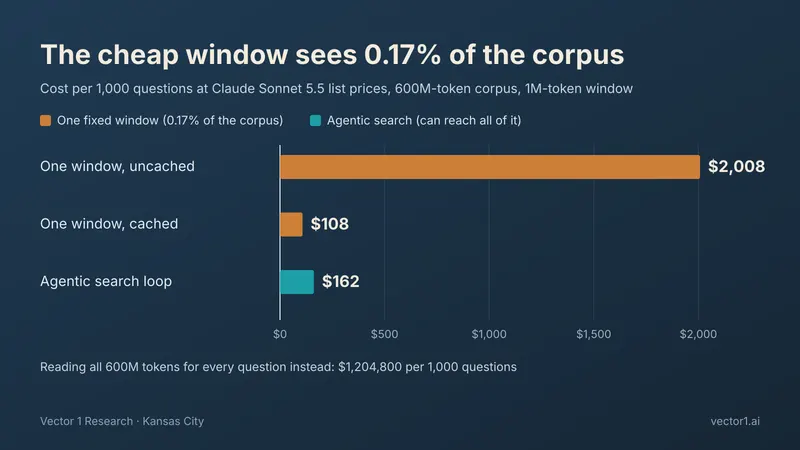
RAG vs Long Context: Why You Can't Just Let Claude Read the Whole Corpus
A 1M-token context window holds 0.17% of a 600M-token corpus, and reading all of it costs $1,204.80 per question at Sonnet 5.5 list prices. One cached window…
Research topic · Kansas City
Language models answer from what they can retrieve, so the structure behind them decides whether an answer is right. Knowledge engineering builds that structure: entities, relationships, definitions and rules that a model or an agent can query. The research here covers knowledge graphs, ontologies and semantic layers, retrieval with GraphRAG and vector search, and the pipelines that keep them current in production.
For inquiries regarding PyCausalSim, Papilon, research citations or technical discussions, reach out directly at [email protected] or connect via GitHub and LinkedIn.
Contact BrianPaste your page titles and your audience's questions to see which demand your content covers, and which questions search and AI answer engines can't find you for.
Open demo →Why a 95%-accurate agent fails most 20-step tasks, and what a verifier, retries and human escalation do to success rates and cost per completed task.
Open demo →A 1M-token context window holds 0.17% of a 600M-token corpus, and reading all of it costs $1,204.80 per question at Sonnet 5.5 list prices. One cached window…
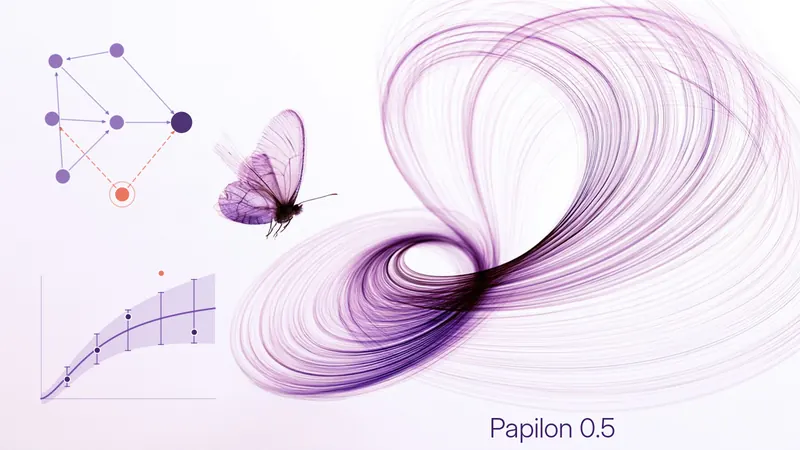
Papilon 0.5 and PyCausalSim 0.5 let a marketing team write down its assumptions, grade a marketing mix model on brands with known returns, and rank which lift…
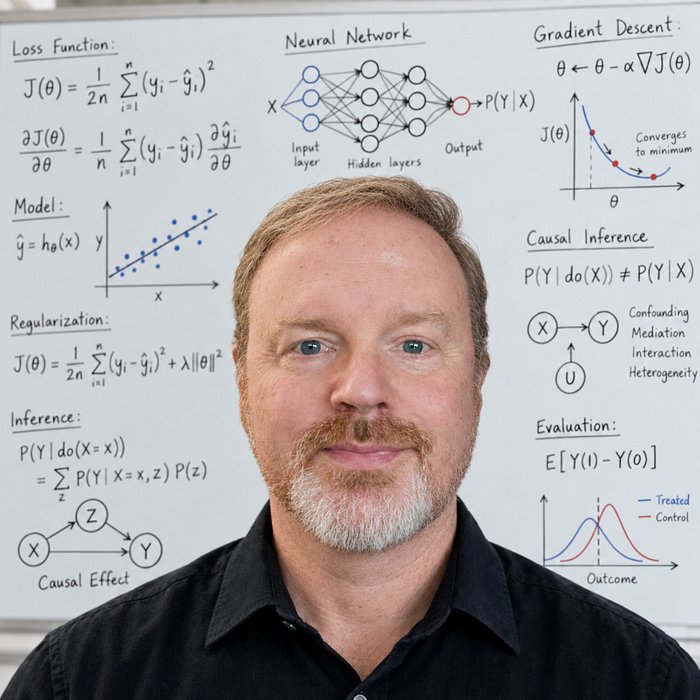
Retrieval internals, graph data modeling, extraction economics, community detection, query-time algorithms, permission-safe summarization, incremental…
Every GEO tool on the market tells you whether you were cited. None of them can tell you why — or predict whether you will be. This article shows how to build…
Two ecosystems are converging on the same problem from opposite ends. On one side sits the open tooling stack for knowledge representation and retrieval:…

“AI fails without context-rich data. No matter how well modeled, data without the context provided by shared semantics and mature ontologies will fall short…

Abstract The proliferation of Retrieval-Augmented Generation (RAG) and Large Language Model (LLM) agents represents a foundational architectural shift — from…
An agent that runs for more than a few minutes has a memory problem. Every tool call, every observation, every intermediate result is something it might need…

You cannot optimize what you cannot observe, and share of answer — the fraction of category prompts where a model cites you — is the wrong place to start…
Knowledge engineering turns what an organization knows into a structure software can use: entities, relationships, definitions and rules, kept current by pipelines and reviewed by people. For AI it supplies the facts and context a model retrieves. Context engineering, a newer term, is about assembling the right context for one model call; knowledge engineering builds the store it draws from.
An ontology defines the types of things and how they may relate. A knowledge graph holds the actual entities and relationships that follow that schema. A semantic layer maps business terms, such as revenue or active customer, to governed definitions over the data, so people and AI agents compute them the same way. Many production systems use all three.
Vector RAG retrieves passages similar to a question and works well for single-fact lookups. GraphRAG retrieves along relationships, which helps when an answer joins facts across documents. It costs more to build and query, so the choice should rest on a test with your own questions, measuring answer quality and cost per answer.
An agent that writes its own query can compute a metric differently each time. A semantic layer gives it governed definitions, so its numbers match the ones finance and the business already report, and its work can be checked against known answers.