AI-First vs Code-First: What Changes When Code Stops Being the Bottleneck
For executives and engineering leaders. AI-first companies ship faster, carry less technical debt, spend less engineering time on low-level work and staff for judgment instead of typing. I built eight AI integrations across an embedded C lifecycle to test where the gains come from, and the interview loop turns out to be the clearest sign of which kind of company you are.

Two kinds of company
For forty years, writing code was the slow, expensive step between an idea and a product. Companies organized around it. They hired for it, measured it, budgeted for it and built their processes to protect it.
That step is getting cheap. An AI coding agent can draft a working module in minutes, and the open-source project behind this article, eight AI integrations with a plugin, a server, 19 tests and a CI pipeline, was built in one working session. When the expensive step gets cheap, the bottleneck moves somewhere else, and companies split into two kinds.
A code-first company treats AI as a faster keyboard. It adds an assistant to the editor and keeps everything else the same: the same roles, the same rituals, the same interview, the same idea that engineering output is code.
An AI-first company treats code as an output of a system that people design, specify and verify. It moves its best people to wherever the new bottleneck is: deciding what to build, writing requirements a machine can check, verifying what gets built, and shortening the path from an idea to a safe release.
Most companies are somewhere in between. This article compares the two on speed, cost, technical debt, product quality and the people they employ, tests the comparison on a real engineering lifecycle, and ends with the fastest way to tell which kind you work for: the interview.
The two companies side by side
| Code-first | AI-first | |
|---|---|---|
| What engineering is | Writing code | Specifying, verifying and shipping behavior |
| Where AI sits | The editor, if approved | Every stage, behind the same gates as human work |
| Where engineer time goes | Maintenance, boilerplate, syntax | Requirements, design, review, experiments |
| Technical debt | Grows with every author's habits | Held down by shared rules that check every change |
| Speed | Limited by how fast people write and review code | Limited by how fast the company can decide and verify |
| Product | Fewer, larger bets | More, smaller experiments |
| Hiring | Live coding, no tools | Work samples with AI, graded on judgment |
| Progress measured by | Code shipped, tickets closed | Defects caught early, time from idea to safe release |
What the company data shows
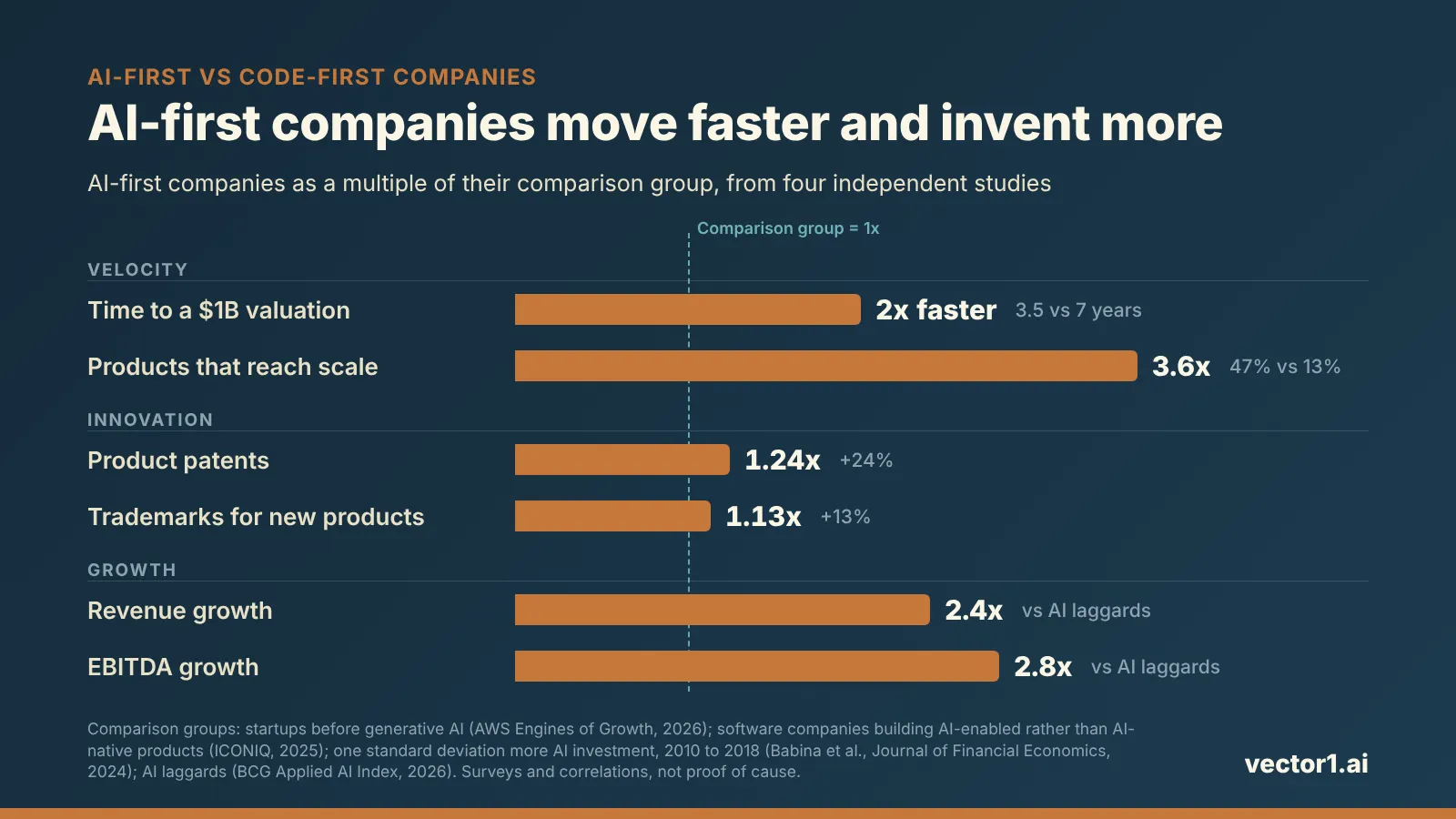
The company-level studies point the same way, on speed, invention and money.
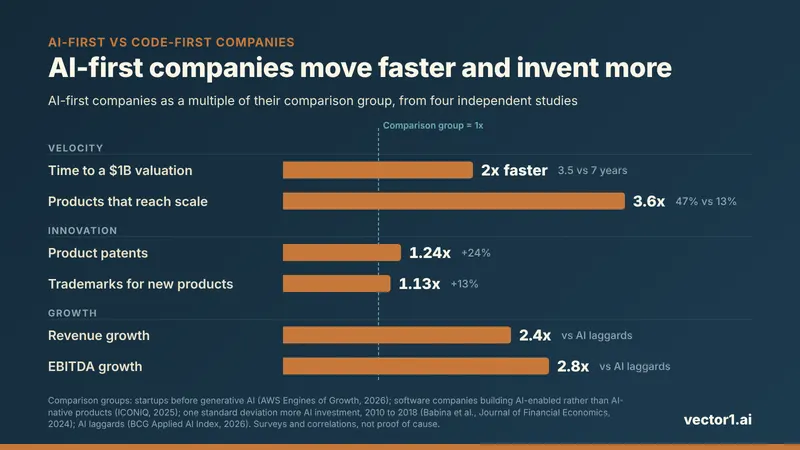
AWS's Engines of Growth study, a 2026 survey of more than 3,400 founders and senior leaders in 20 countries, found that AI-native startups reach a billion-dollar valuation in about 3.5 years, half the time it took before generative AI, with half the staff, and grow revenue 156% a year against 65% for startups overall. In ICONIQ's 2025 survey of 300 software executives, 47% of AI-native companies had reached scale with proven market fit, against 13% of companies building AI-enabled products. BCG's Applied AI Index 2026, a survey of 1,330 executives, found that the 7.5% of companies it classifies as future-built deliver 2.4 times the revenue growth, 2.8 times the EBITDA growth and 2.3 times the shareholder return of AI laggards.
The innovation evidence is the most rigorous and the most modest. Tania Babina, Anastassia Fedyk, Alex He and James Hodson measured AI investment at US public companies from employee resumes. From 2010 to 2018, one standard deviation more AI investment went with 24% more product patents, 13% more trademarks and around 20% more sales growth over a decade, and the growth came from new and better products, not from cutting costs.
None of this proves cause. Surveys let companies classify themselves, startups that build on AI may differ in other ways, and a maturity score can end up sorting the winners. What the studies agree on is where the gap shows up: in how fast companies get products to scale and how many new products they make, not in how fast anyone types.
Where engineering time goes today
The case for AI-first starts with how little engineering time goes into building anything new. In Stripe's Developer Coefficient survey, developers reported spending 17.3 hours of a 41.1-hour week on maintenance: 13.5 hours on technical debt and 3.8 on fixing bad code. That is 42% of the week spent on the past. The survey is from 2018 and self-reported, but the shape matches what most engineering leaders see.
The debt also shows up on the balance sheet. In a McKinsey survey, CIOs estimated technical debt at 20 to 40 percent of the value of their entire technology estate, and reported that 10 to 20 percent of the budget meant for new products goes to dealing with it instead. McKinsey also found that companies in the top fifth on its technical debt score had revenue growth 20 percent higher than those in the bottom fifth.
That is the money an AI-first company goes after. The opportunity is less in writing new code faster than in spending less of the week on the code you already have.
A simple capacity model makes the stakes concrete. If H is the work week, s the share spent on maintenance and r the share of that maintenance an AI-first setup removes, the hours returned to new work each week are:
With Stripe's figures (H = 41.1, s = 0.42) and an assumed r = 0.3, each developer gets about 5.2 hours a week back, roughly 13% of engineering capacity. The value of r is an assumption, not a measurement, and the rest of this article is about what it takes to make it real.
Speed: the evidence is mixed, and the mix is the point
The headline studies disagree. In a controlled experiment by researchers at GitHub, Microsoft and MIT, developers with an AI pair programmer completed a contained task, building an HTTP server in JavaScript, 55.8% faster than the control group. In a randomized trial by METR in early 2025, experienced open-source developers working on their own large repositories took 19% longer with AI tools, even though they believed afterward that AI had made them about 20% faster.
Google's DORA research ties the two together. Its 2025 report, built on nearly 5,000 survey responses, calls AI an amplifier: it magnifies a team's existing strengths and weaknesses. AI adoption now improves delivery throughput, but it also raises delivery instability.
Read together, these say the same thing. Dropping an assistant into an unchanged process speeds up small, well-defined tasks, slows down experts working in large codebases, and ships more breakage. That is the code-first result. The gains come when the process around the code changes: clear requirements, shared rules that check every change, evaluations, and review aimed at what matters.
The experiment: AI at every stage of an embedded C lifecycle
To test that, I picked the hardest case for the AI-first argument: embedded C, where code ships on devices, a memory bug can brick hardware, and engineers are rightly skeptical of code they did not write.
Firmware moves through eight stages: requirements, design, code, unit tests, static analysis, code review, build and hardware-in-the-loop tests, and release with field monitoring. I built one AI integration for each, plus a Claude Code plugin with skills and hooks, an MCP server with seven read-only tools, and an evaluation harness, and ran it against a sample firmware project for a wrist-worn heart-rate sensor with seven defects planted in the code, the requirements and a pending change. One offline run, with no model calls, produced 44 findings, 16 of them high severity, and blocked 5 of 8 gates. The interactive demo lets you switch the stages on and off.
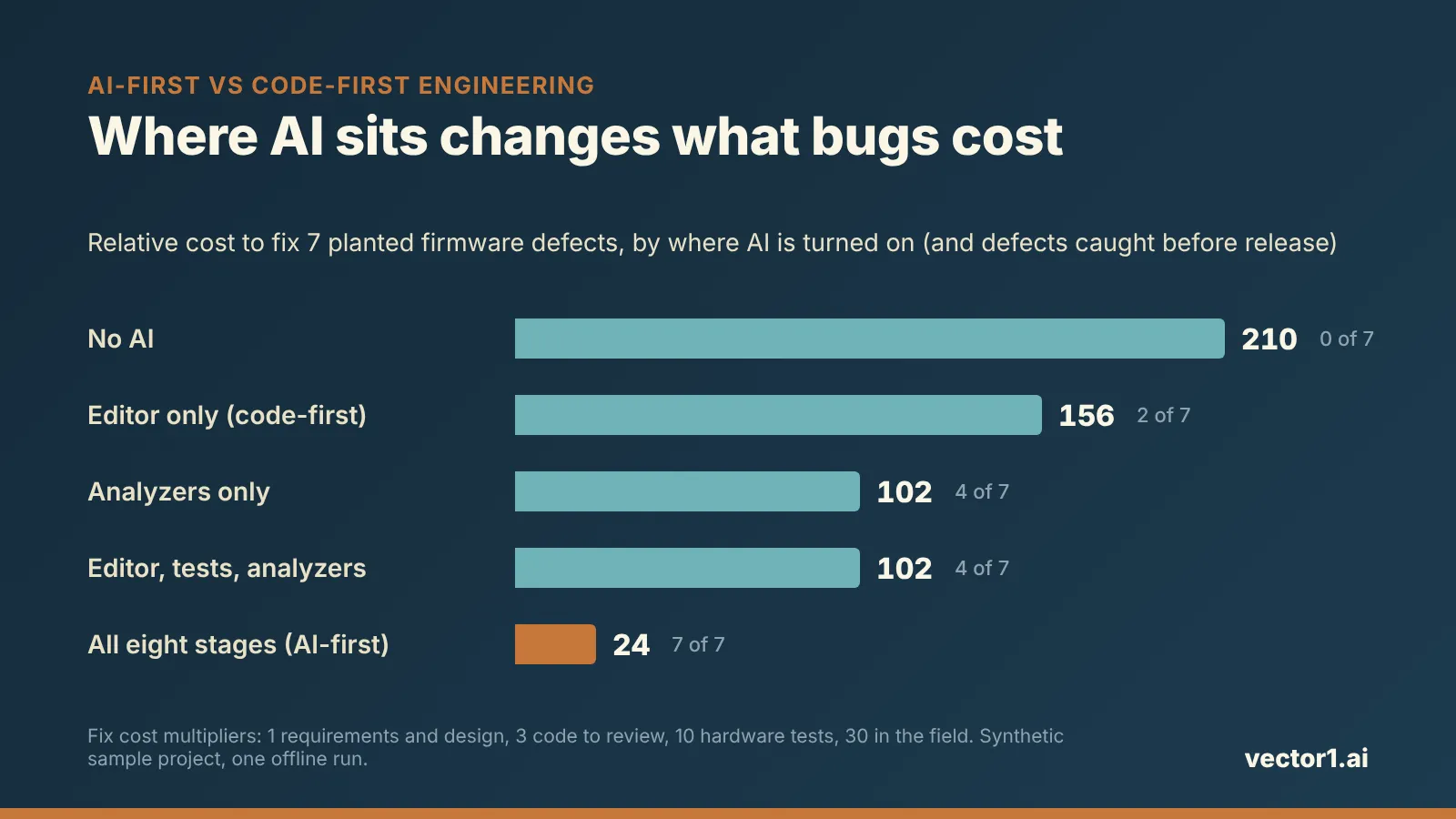
Every defect is fixed at the first stage that catches it, so each way of deploying AI has a total fix cost:
D is the set of defects, S_d the stages that flag defect d, E the stages where AI is turned on, and m(s) the relative cost of a fix at stage s. A defect that no enabled stage catches before release costs the field multiplier. Boehm and Basili put the ratio between a fix after delivery and a fix during requirements and design at about 5:1 for small, noncritical systems and often 100:1 for large ones, and Laurent Bossavit has argued that the evidence behind such curves is thin, so the defaults are modest: 1 for requirements and design, 3 for code through review, 10 for hardware tests, 30 in the field.
DEFECTS = {
    "cmd_parse(): strcpy before the length check": [2, 3, 4, 5, 7, 8],
    "hr_sensor_isr(): ISR-shared value not volatile": [3, 5],
    "rb_peek_at(): index not bounds-checked": [4, 5, 7, 8],
    "cmd_parse(): atoi with no error check": [5],
    "REQ-002: untestable requirement wording": [1],
    "battery_monitor change: delay in ISR, heap, underflow": [6],
    "pm_flush_to_flash(): brown-out regression": [7, 8],
}
MULTIPLIER = {1: 1, 2: 1, 3: 3, 4: 3, 5: 3, 6: 3, 7: 10, 8: 30}
FIELD = 30


def fix_cost(enabled, multiplier=MULTIPLIER, field=FIELD):
    total, caught = 0, 0
    for stages in DEFECTS.values():
        hits = [s for s in stages if s in enabled and s < 8]
        total += multiplier[min(hits)] if hits else field
        caught += bool(hits)
    return total, caught


if __name__ == "__main__":
    for name, on in {"No AI": set(), "Editor only": {3}, "Analyzers only": {5},
                     "Editor, tests, analyzers": {3, 4, 5}, "All eight": set(range(1, 9))}.items():
        print(name, fix_cost(on))
The code-first setup, AI in the editor only, catches 2 of the 7 defects before release: 2 × 3 + 5 × 30 = 156. Adding generated tests and static analysis catches 4 of 7, at 102. AI at all eight stages catches all 7: the requirement defect at stage 1 (1), the strcpy at stage 2 (1), three code defects at stages 3 to 5 (9 in total), the risky change at review (3) and a brown-out regression on the hardware rig (10), for 24. That is 85% lower than editor only. The direction holds across the published range: at the 5:1 end the editor-only setup costs 2.7 times as much, at the 100:1 end 12.1 times.
What the experiment says about the two companies
Speed comes from the stages around the code. The editor hook, the generated tests and the analyzers overlapped almost completely: they caught the same code defects, and all three together cost exactly what the analyzers alone cost. The defects that drove the total were the ones only one stage could see: an untestable requirement ("the filter should smooth readings quickly"), a risky change with a delay inside an interrupt handler, and a flash timing failure under falling voltage that only the hardware rig reproduces. None of those catches depends on typing faster.
Technical debt is a rules problem. The firmware rules in the repository (no heap, nothing blocking in an interrupt handler, shared interrupt state declared volatile, bounded string handling) run in three places: a hook after every AI edit, the static-analysis gate and the review bot. A rule written once checks every change, whoever or whatever wrote it. That is how an AI-first company keeps fast code from becoming fast debt, and it answers DORA's instability finding directly.
Institutional memory beats typing speed. The most expensive bug in the sample, the strcpy in the command parser, was flagged at six stages. The earliest was stage 2, where a search over past design documents found an old UART design whose risk section already warned that length must be checked before any copy. The cheapest catch came from what the company already knew.
Cheap building changes the product. When a working prototype takes an afternoon, a team can test three approaches with users instead of debating one in a meeting. The constraint on product quality moves from engineering capacity to the quality of the questions the company asks and how quickly it can measure the answers. That is where AI-first companies get better products and more innovation: more experiments per quarter, each one cheaper to run and easier to throw away.
Who works in an AI-first company
When code is not the bottleneck, the work does not disappear. It moves. These are the roles that grow, what each one owns and how it differs from the code-first version.
| Role | What they own | What changed |
|---|---|---|
| Problem owner | Which problem to solve, for whom, and how success is measured | Requirements become the main engineering input, so they must be testable |
| Specification engineer | Turning intent into requirements, acceptance criteria and evaluation cases a machine can check | Replaces much of the ticket-writing and hand-off between product and engineering |
| System and workflow architect | How agents, tools, data and people connect: MCP servers, skills, hooks, context | Designs the system that produces code instead of writing most of it |
| Verification engineer | Reviewing AI-written changes, owning the gates, saying what is safe to ship | The old senior-reviewer role, now the center of engineering |
| Evaluation engineer | Golden test sets, model comparisons, cost per successful task, drift over time | New: nobody measured the quality of a keyboard |
| Domain expert in the loop | Hardware, safety, clinical or financial knowledge that decides what correct means | Moves upstream into requirements and review |
| Experiment designer | Running product bets, measuring causal effects, deciding what to keep | Grows because building is cheap and choosing is not |
| AI platform steward | Approved tools, private endpoints, data boundaries, training and adoption | A fast lane for new tools with guardrails, measured in weeks |
The work that shrinks is the work that was always closest to typing: boilerplate, hand-written glue code, routine refactoring, first-draft tests, report scripts and manual log reading. The people who did it do not become unnecessary. Their judgment about what correct looks like becomes more valuable once something else is producing the first draft.
The interview gives it away
A job posting tells you what a company wants to be. Its interview loop tells you what it believes engineering is.
A code-first company runs a live coding round with no tools: write the function from memory while someone watches. In a randomized trial at North Carolina State University and Microsoft, 48 computer science students solved whiteboard problems either alone or watched by an interviewer, and performance was reduced by more than half just by being watched. That format tests stage fright and recall, which are not the skills the roles above need.
An AI-first company hires for judgment. In June 2025 Canva replaced its Computer Science Fundamentals screen with an AI-assisted coding round for backend, frontend and machine learning roles, and expects candidates to use tools like Copilot, Cursor and Claude. The round grades whether a candidate can find and fix problems in code the AI wrote. Meta has piloted a coding round with an AI assistant available.
The sample project in the repository works as an interview kit, because every defect is planted and the pipeline's output is the answer key. A loop built on it has four parts: find and rewrite the untestable requirements; review an AI-written change with any tools and rank what you find; separate regressions from flaky tests using rig logs and crash dumps; and design where AI belongs in the lifecycle and which data must never leave the company's tenant. Keep one short check without tools: read a page of C and say whether it is safe. That is the honest core of the old coding interview, and it matters more when an AI writes the first draft.
Five other hiring rituals mark a code-first company. GPA cutoffs and degree lists for people with fifteen years of experience select for who they were at twenty-two. "Years of language X" requirements measure time, not judgment. AI enablement roles placed inside the software engineering job family inherit its coding interview. Tool approval that takes a year means always evaluating last year's tool. And counting lines and tickets rewards volume, which is now nearly free.
The fair case for code-first
The cautious side has real points.
Developers use AI and do not fully trust it. In Stack Overflow's 2025 survey, 84% of respondents were using or planning to use AI tools, and more of them actively distrusted the accuracy of AI tools (46%) than trusted it (33%). The METR result shows that experienced engineers in large codebases can be slowed down, and DORA shows that more throughput can mean more instability. These are reasons to make verification the center of the job, not reasons to keep the old one.
Safety-critical code needs people who can read it. Certified aviation software, medical devices and anything under export control carry obligations a model cannot sign for. An AI-first company keeps those obligations and moves people from writing every line to proving every line.
AI-first does not mean AI-careless. Every gate in the experiment is deterministic: rules, analyzers, sanitizers and test results decide pass or fail, and a model only drafts improvements on top. Source code reaches a model only through a private endpoint or a self-hosted model.
Where this argument breaks
The defects in the experiment were planted, and planted defects are easier to catch than ones nobody knows about. The cost model treats every flag as a fix, prices false positives at zero and uses one multiplier per phase. The firmware rules are regex checks, not a MISRA checker, and the golden test cases were written alongside the rules, so their perfect score proves only that the code does what its author intended.
The business evidence is uneven too. The Stripe figures are self-reported and from 2018, the McKinsey figures are CIO estimates, and the link between technical debt and revenue growth is a correlation that a strong company could explain in either direction. The capacity model's 30% reduction is an assumption. The claim is narrower than "AI makes companies more profitable": the companies that change their process, roles and hiring around AI are the ones positioned to collect the gains, and the ones that only add an editor assistant mostly are not.
Five questions to tell which company you are
- Where does AI sit in your lifecycle: the editor only, or every stage?
- What share of engineering time goes to maintenance, and is it falling?
- Are your team's rules encoded where an AI must follow them, in hooks and CI, or only in reviewers' heads?
- Which of the roles above exist in your org chart today?
- Can a candidate use AI in your technical interview, and is it graded on what they catch or on what they type?
If the answers are the editor, you don't know, reviewers' heads, none of them and no, the company is code-first, whatever its strategy deck says. Start with the second question. It shows where AI can return time to new work, and the other four show what has to change to collect it.
The code, the sample project and the plugin are on GitHub at Bodhi8/firmware-ai-lifecycle under the MIT licence, and the demo runs the cost model in your browser.
Sources
- Amazon Web Services, "AWS global startup trends report reveals AI-native startups are reaching billion-dollar valuations in half the time," June 2026. press.aboutamazon.com
- ICONIQ, "2025 State of AI Report: The Builder's Playbook." iconiqcapital.com
- BCG, "AI is starting to pay off" (Applied AI Index 2026), September 30, 2026. bcg.com
- Tania Babina, Anastassia Fedyk, Alex He and James Hodson, "Artificial intelligence, firm growth, and product innovation," Journal of Financial Economics, 2024. DOI
- Tania Babina and Anastassia Fedyk, "The effects of AI on firms and workers," Brookings, 2025. brookings.edu
- Stripe, "The Developer Coefficient," 2018. stripe.com
- McKinsey, "Tech debt: Reclaiming tech equity." mckinsey.com
- McKinsey, "Demystifying digital dark matter: A new standard to tame technical debt." mckinsey.com
- Sida Peng, Eirini Kalliamvakou, Peter Cihon and Mert Demirer, "The Impact of AI on Developer Productivity: Evidence from GitHub Copilot," 2023. arXiv
- METR, "Measuring the Impact of Early-2025 AI on Experienced Open-Source Developer Productivity," 2025. GreaterWrong mirror
- DORA, "State of AI-assisted Software Development," 2025. Google Cloud
- Mahnaz Behroozi, Shivani Shirolkar, Titus Barik and Chris Parnin, "Does Stress Impact Technical Interview Performance?," ESEC/FSE 2020. Conference page
- Australian Computer Society, "Canva insists job applicants use AI coding in interviews," 2025. ia.acs.org.au
- Stack Overflow, "2025 Developer Survey: AI." survey.stackoverflow.co
- Barry Boehm and Victor R. Basili, "Software Defect Reduction Top 10 List," IEEE Computer 34(1), 2001. Copy at DePaul
- Laurent Bossavit, The Leprechauns of Software Engineering, Leanpub. Leanpub
Brian Curry | Vector 1 Research, Kansas City. More research and live demos at vector1.ai.