How Sensitive Should a Machine Vision Inspection Camera Be? Defect Escapes vs. False Rejects
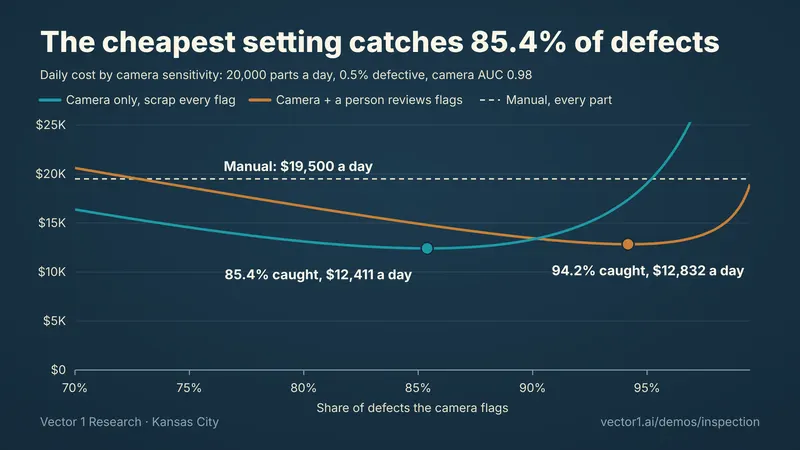
On a simulated line of 20,000 parts a day with 0.5% defective, a computer vision model with an AUC of 0.98 has to flag 2,163 parts a day to catch 95% of…
Research topic · Kansas City
Most of the value in machine learning comes from the plain work: framing the decision, building a model that fits it, checking it against data where the answer is known, and keeping it right once it runs. The research here covers that work across marketing, energy, healthcare, finance and manufacturing, with and without agents, and publishes the code.
For inquiries regarding PyCausalSim, Papilon, research citations or technical discussions, reach out directly at [email protected] or connect via GitHub and LinkedIn.
Contact BrianSelf-hosting an LLM costs $10.42 or $1.49 per million tokens on the same hardware. The difference is utilization; find your break-even against API pricing.
Open demo →Tune an AI inspection camera's sensitivity and see the tradeoff between defects that escape to customers and good parts thrown away, with and without a person reviewing flags.
Open demo →Why a model with a strong AUC can still bury nurses in false alarms: alerts per day, false alarms per real case and missed cases, from the same four numbers.
Open demo →Fund, verify or decline a factored freight invoice: expected dollars per action, plus a synthetic portfolio with fraud rings planted in it.
Open demo →Watch an agent take a discount campaign from brief to a deployed model: data checks, a holdout gate, your sign-off, a canary launch and monitoring that pauses it when results slip.
Open demo →On a simulated line of 20,000 parts a day with 0.5% defective, a computer vision model with an AUC of 0.98 has to flag 2,163 parts a day to catch 95% of…
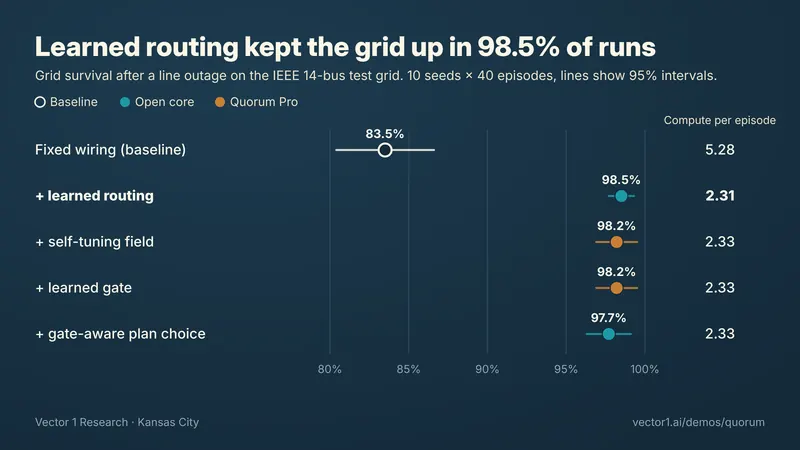
Quorum lets plain, auditable machine learning decide how a swarm of AI agents is organized, with humans setting the goals and the limits. On a simulated grid…
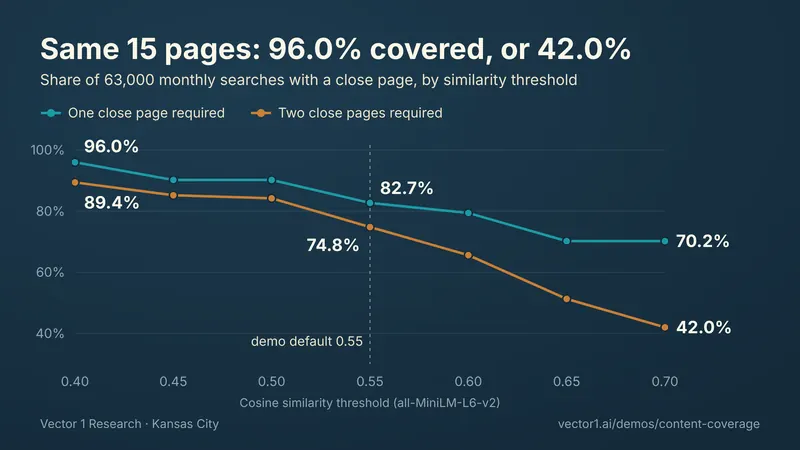
The same 15 pages cover 96.0% or 70.2% of a 63,000-search demand list depending on one similarity threshold. Here is the Python, a way to set the threshold…
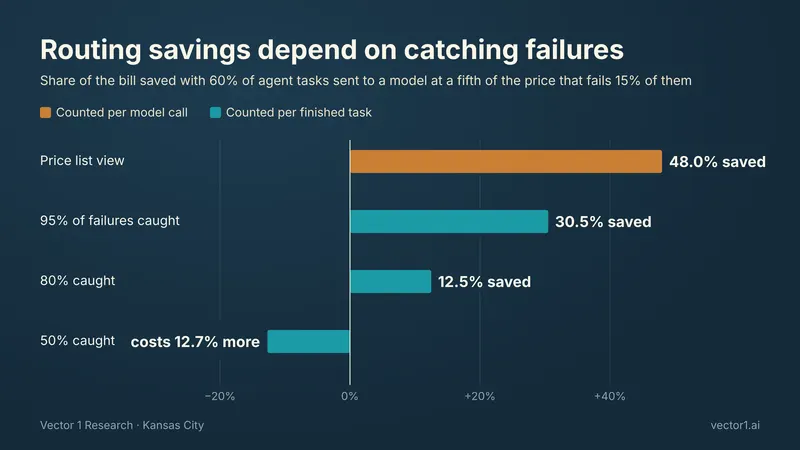
Routing 60% of agent tasks to a model at a fifth of the price looks like a 48% saving. Counted per finished task, it saves 30.5% when 95% of the cheap model's…
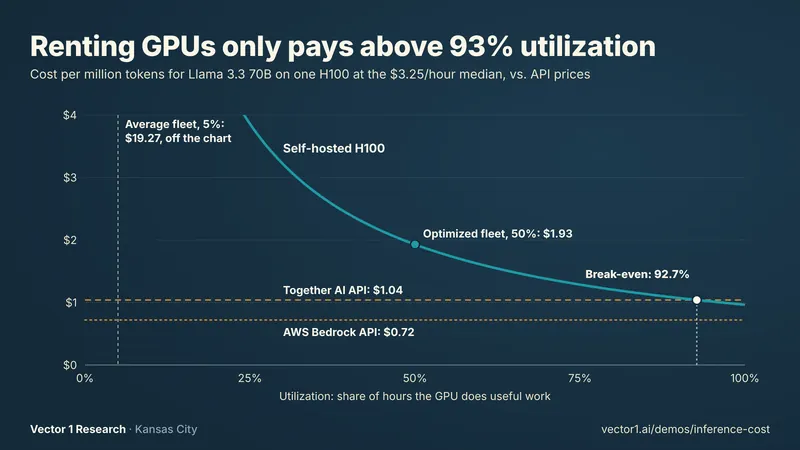
An LLM inference cost calculator for self-hosted GPUs vs. an API. At 2026 H100 prices, an API wins for a 70B model unless GPUs stay 93% busy.

Modern enterprise data science suffers from a persistent delusion: the belief that sufficient parameter scale, rich multimodal embeddings, and massive compute…

Machine learning could not beat the NYMEX natural gas futures curve. A causal simulation built on it can still improve the decisions that ride on Henry Hub:…

Ep 4 Hospital Capacity and Patient Flow Some of the deadliest delays in a hospital happen after the diagnosis. The doctors have decided a patient needs a bed,…

Ep 3 Stroke Detection at the Scanner When a clot blocks one of the large arteries of the brain, the patient loses about 1.9 million neurons every minute. The…
Analytics describes what happened and why, usually with metrics, comparisons and dashboards. Machine learning builds models that predict or classify new cases. Most useful projects need both: analytics to define the decision and the metric, and a model only where prediction beats a rule.
Test it on data it has not seen, against a simple baseline, using the metric the decision depends on. Where possible, test it on simulated data where the true answer is known, so you can see whether it recovers the truth and not just whether it fits.
When utilization is high and steady enough that a dedicated GPU costs less per million tokens than the API, or when data rules require it. At low or bursty volume an API is usually cheaper; the LLM inference cost calculator shows the break-even.
Agents can run parts of the workflow, such as data checks, feature work, backtests and reports, faster than a person can. The model still has to pass the same validation, so the checks matter more, not less. The agentic machine learning hub covers that layer.
Yes. The demos run in your browser and the code behind the research is open source on GitHub.